The four layers of the MERN stack: MongoDB, Express.js, React and Node.js.

What is the MERN stack? A beginner's guide

Codemithra Team

Codemithra Team

MERN stands for MongoDB, Express.js, React and Node.js. These are four JavaScript-based technologies used together to build a web application. MongoDB stores the data. Express.js and Node.js run the server and the API. React builds the screens the user sees. Every layer speaks JavaScript, and the layers pass data around as JSON. This suits a dynamic, single-page application that reads and writes data through an API. This guide explains what each layer does, how a request moves through all four, and where MERN fits against MEAN and MEVN.

The four layers of MERN

Each letter in MERN names a separate piece of software with its own job. Read each one on its own terms before you look at how they connect.

MongoDB: the database

MongoDB is a document database. It stores data in flexible, JSON-like documents (MongoDB, "What is MongoDB?"). Fields can vary between documents in the same collection. This suits data that does not fit neatly into fixed rows and columns. MongoDB describes itself as a distributed database at its core. It has built-in replication for high availability and native sharding for horizontal scaling (MongoDB, "What is MongoDB?"). In a MERN app, this is where user records, posts or to-do items live.

Express.js: the web framework

Express.js is a minimal and flexible Node.js web application framework. Its own site describes it as "fast, unopinionated, minimalist" (Express.js homepage). It sits on top of Node.js and gives you routes, middleware, and request and response handling. You do not write raw HTTP-handling code for every endpoint. In a MERN app, Express.js defines the API routes that React calls, and that read from and write to MongoDB.

React: the user interface

React describes itself as "the library for web and native user interfaces" (React.dev), not a full framework. Jordan Walke created it at Facebook, and it was used internally from 2011 (React, Wikipedia). It was announced publicly at JSConf US in May 2013. Today a distributed team maintains it, spanning Meta, Vercel, Expo, Microsoft and other companies (React team page). In a MERN app, React renders the pages in the browser and calls the Express.js API for data.

Node.js: the server runtime

"As an asynchronous event-driven JavaScript runtime, Node.js is designed to build scalable network applications" (Node.js, "About Node.js"). It lets JavaScript run outside a browser, on a server, which is what makes an all-JavaScript stack possible. One common but incorrect claim is that Google built Node.js for Chrome. Google did build the V8 JavaScript engine for Chrome. Google open-sourced V8 on 2 September 2008, the same day Chrome launched (V8 team, "Celebrating 10 years of V8"). Node.js is a separate project. Ryan Dahl created it and first presented it in 2009 (Node.js, Wikipedia). He chose to run it on V8 rather than build his own engine. V8 itself is Google's open source JavaScript and WebAssembly engine, used in both Chrome and Node.js (V8 JavaScript engine). Node.js was never a Google product.

How the four layers talk to each other

Naming the four pieces does not show how they work together. A single request through a MERN app follows a fixed path, shown below for a to-do list example.
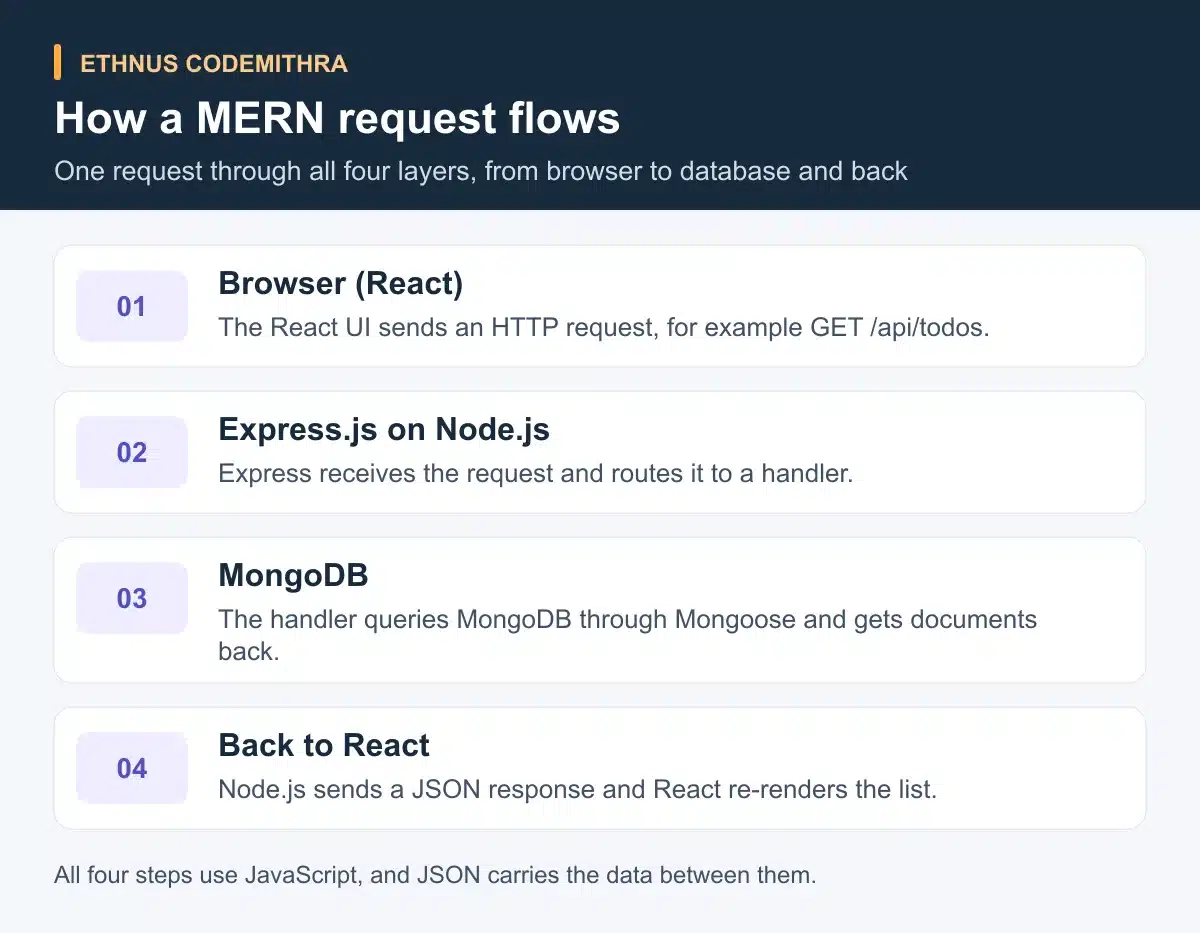
Diagram of a MERN stack request flow
A single MERN request: React sends the request, Express.js on Node.js routes it, MongoDB returns data, and React re-renders.

The browser never talks to MongoDB directly. React always goes through Express.js, and Express.js is the only layer that queries the database. This separation lets you change the front end, the API or the database on its own. The API contract between them has to stay the same.

A minimal working example

The two snippets below show the pattern from the diagram in code. The first is an Express.js route running on Node.js. It reads from MongoDB through Mongoose, a library for modelling MongoDB data in Node.js. The second is a React component that calls that route and renders the result. Treat this as a teaching example to type out and run, not a specific project from any Ethnus batch.

const mongoose = require('mongoose');

const Todo = mongoose.model('Todo', new mongoose.Schema({
  text: String,
  done: Boolean,
}));

app.get('/api/todos', async (req, res) => {
  const todos = await Todo.find();
  res.json(todos);
});
function TodoList() {
  const [todos, setTodos] = useState([]);

  useEffect(() => {
    fetch('/api/todos')
      .then((response) => response.json())
      .then(setTodos);
  }, []);

  return (
    <ul>
      {todos.map((todo) => (
        <li key={todo._id}>{todo.text}</li>
      ))}
    </ul>
  );
}

Try this today. Set up a local MongoDB instance or a free MongoDB Atlas cluster. Add the Express.js route above to a small Node.js server, and call it from the React component. Watch the browser's network tab to see the JSON travel from MongoDB to Express.js and back to React.

When MERN fits, and when it might not

MERN suits applications with JSON-heavy data and a dynamic, single-page interface. Three common examples show why.

  • To-do and calendar apps: the data is a simple list of documents. React can update the list without reloading the page.
  • Discussion forums: posts and replies map naturally onto MongoDB documents. Express.js can expose one API for both reading and posting.
  • Social feed apps: a stream of posts, likes and comments benefits from React re-rendering only the parts of the page that change.

MERN fits less well for an application built mainly around fixed, heavily related tables. A project needing complex joins across many entities, or a team with deep experience in another stack, may not gain much by switching. Choosing a stack because it is popular is not the same as choosing it because it matches the project.

MERN compared with MEAN and MEVN

MongoDB, Express.js and Node.js also appear in two other common JavaScript stacks. Each one swaps out the front-end layer. Every front end describes itself differently in its own documentation. No official benchmark supports a claim that one stack performs better than the others. The table below compares descriptions and shared components, not performance.

Stack Frontend layer Frontend's own description Shared backend
MERN React "The library for web and native user interfaces" (react.dev) MongoDB, Express.js, Node.js
MEAN Angular "A web framework" (angular.dev) MongoDB, Express.js, Node.js
MEVN Vue.js "A JavaScript framework for building user interfaces" (vuejs.org) MongoDB, Express.js, Node.js

Current Angular is a different codebase from AngularJS (1.x). AngularJS support has officially ended as of January 2022 (AngularJS, "Version Support Status"). A "MEAN stack" reference today means Angular, not the retired AngularJS.

Try this as an exercise. Pick two project ideas you have in mind and check them against the table. If your team already knows Angular, MEAN may need less new learning. If you want a UI library rather than a full framework, MERN or MEVN fit better. There is no universally correct answer, only a better fit for a given team and project.

Learning MERN at Ethnus

Ethnus Codemithra's MERN Full Stack course pairs a 250-plus hour basic essentials course with a 200-plus hour full stack course. The frontend curriculum covers HTML5, CSS3, Bootstrap, JavaScript (ES6), TypeScript and React. The backend curriculum covers Node.js, Express.js and MongoDB. The MongoDB module covers CRUD operations, aggregations and indexing. The Express.js module covers templating and middleware. The React module covers components, routing, forms and testing with Jest. The Node.js module covers modules, the event loop and the file system. The program includes trainer-led sessions with step-by-step walkthroughs and module-based assignments. Placement preparation activities include a resume-building workshop and practice interviews. The course ends with a certificate covering HTML, CSS, Bootstrap, JavaScript, MongoDB, Express.js, React and Node.js.

Frequently asked questions

Is MERN a framework?

No. MERN combines four separate technologies: a database (MongoDB), a web framework (Express.js), a UI library (React) and a runtime (Node.js). Express.js is a framework, but React describes itself as a library (react.dev).

Did Google build Node.js?

No. Google built the V8 engine that Node.js runs on. Google open-sourced V8 in 2008 alongside Chrome's launch (V8 team, "Celebrating 10 years of V8"). Ryan Dahl created Node.js separately in 2009 (Node.js, Wikipedia).

Do I need to learn all four technologies before I start?

You need enough JavaScript to read and write functions and objects first. Ethnus Codemithra's MERN course starts with HTML5, CSS3 and JavaScript fundamentals. It then moves into React, Node.js, Express.js and MongoDB (MERN Full Stack course).

Is MERN faster than MEAN or MEVN?

No official, citable benchmark supports a claim that MERN performs better than MEAN or MEVN. The right choice depends on your team's existing skills and the project's requirements, not a fixed performance ranking.

If you want to move from reading about MERN to building with it, start with JavaScript fundamentals. Ethnus Codemithra's MERN Full Stack course then covers all four layers with trainer-led sessions and module-based assignments.
About the Author

Read More

Ethnus User Agreement

I agree to submit my personally identifiable information to Ethnus, who may use it to communicate regarding their events, courses, and other services through various media including phone calls, text messages, email, and social media. I also agree with Ethnus' Privacy Policy and Terms of Service.

I agree with Ethnus sharing my personal data, including email address, with Salesforce family of companies, who may contact me for sales and marketing purposes and as described in Salesforce's Privacy Statement.

Privacy Policy

This Privacy Notice describes how we collect and use your personal information in relation to Ethnus websites, applications, products, services, events, and experiences that reference this Privacy Notice (together, "Ethnus Offerings").

This Privacy Notice does not apply to the "content" processed, stored, or hosted by our customers using Ethnus Offerings in connection with an Ethnus account. This Privacy Notice also does not apply to any products, services, websites, or content that are offered by third parties or have their own privacy notice.

Personal Information We Collect

We collect your personal information in the course of providing Ethnus Offerings to you.

Here are the types of information we gather:

        a) Information You Give Us: We collect any information you provide in relation to Ethnus Offerings. Click here to see examples of information you give us. Example: Name, email, phone, etc.

        b) Automatic Information: We automatically collect certain types of information when you interact with Ethnus Offerings. Example: IP address, location, browser identity, etc.

        c) Information from Other Sources: We might collect information about you from other sources, including service providers, partners, and publicly available sources. Example: marketing analytics, keywords, etc.

How We Use Personal Information

We use your personal information to operate, provide, and improve Ethnus Offerings. Our purposes for using personal information include:

        a) Provide Ethnus Offerings: We may use your personal information to provide and deliver Ethnus Offerings and process transactions related to Ethnus Offerings, including registrations, subscriptions, purchases, and payments.

        b) Measure, Support, and Improve Ethnus Offerings: We use your personal information to measure use of, analyze the performance of, fix errors in, provide support for, improve, and develop Ethnus Offerings.

        c) Recommendations and Personalization: We use your personal information to recommend Ethnus Offerings that might be of interest to you, identify your preferences, and personalize your experience with Ethnus Offerings.

        d) Comply with Legal Obligations: In certain cases, we have a legal obligation to collect, use, or retain your personal information.

        e) Communicate with You: We use your personal information to communicate with you in relation to Ethnus Offerings via different channels (e.g., by phone, email, chat) and to respond to your requests.

        f) Marketing: We use your personal information to market and promote Ethnus Offerings. We might display interest-based ads for Ethnus Offerings.

        g) Purposes for Which We Seek Your Consent: We may also ask for your consent to use your personal information for a specific purpose that we communicate to you.

Cookies

To enable our systems to recognize your browser or device and to provide Ethnus Offerings, we use cookies.

How We Share Personal Information

Information about our customers is an important part of our business and we are not in the business of selling our customers' personal information to others. We share personal information only as described below and with Ethnus Consultancy Services Private Limited, . and its affiliates that are either subject to this Privacy Notice or follow practices at least as protective as those described in this Privacy Notice.

Transactions Involving Third Parties: We make available to you services, software, training, and content provided by third parties for use on or through Ethnus Offerings. You can tell when a third party is involved in your transactions, and we share information related to those transactions with that third party. For example, you can order services, software, and content from sellers using the Authorized Training Partner's marketplace and we provide those sellers information to facilitate your subscription, purchases, or support.

Other than as set out above, you will receive notice when personal information about you might be shared with third parties, and you will have an opportunity to choose not to share the information.

How We Secure Information

        a) We protect the security of your information during transmission to or from websites, applications, products, or services by using encryption protocols and software.

        b) We maintain physical, electronic, and procedural safeguards in connection with the collection, storage, and disclosure of personal information.

Internet Advertising and Third Parties

Ethnus Offerings may include third-party advertising and links to other websites and applications. Third party advertising partners may collect information about you when you interact with their content, advertising, or services. For more information about third-party advertising, including interest-based ads, please read our Interest-Based Ads notice.

Access and Choice

You have choices about the collection and use of your personal information. Many Ethnus Offerings include settings that provide you with options as to how your information is being used. You can choose not to provide certain information, but then you might not be able to take advantage of certain Ethnus Offerings.

        a) Communications: If you do not want to receive promotional messages from us, please unsubscribe or adjust your communication preferences in the emails.

        b) Advertising: If you don't want to see interest-based ads, please adjust your Advertising Preferences.

        c) Browser and Devices: The Help feature on most browsers and devices will tell you how to prevent your browser or device from accepting new cookies, how to have the browser notify you when you receive a new cookie, or how to disable cookies altogether.

Children's Personal Information

We don't provide Ethnus Offerings for purchase by children. If you're under 18, you may use Ethnus Offerings only with the involvement of a parent or guardian.

Retention of Personal Information

We keep your personal information to enable your continued use of Ethnus Offerings, for as long as it is required in order to fulfill the relevant purposes described in this Privacy Notice, as may be required by law (including for tax and accounting purposes), or as otherwise communicated to you. How long we retain specific personal information varies depending on the purpose for its use, and we may delete your personal information in accordance with applicable law.

Contacts, Notices, and Revisions

If you have any concern about privacy at Ethnus, you may also contact us at the addresses below:

Ethnus Consultancy Services Pvt Ltd,

SST Chambers, No.151/17/1 Second Floor, 36th Cross Rd, 5th Block, Jayanagar, Bengaluru, Karnataka 560041

Or, email us at [email protected]

Or call us at: +91 - 8929 334 324

You will find the updated contact information on our website: www.ethnus.com/contact/

If you interact with Ethnus Offerings on behalf of or through your organization, then your personal information may also be subject to your organization's privacy practices, and you should direct privacy inquiries to your organization.

Our business changes constantly, and our Privacy Notice may also change. You should check our website frequently to see recent changes. You can see the date on which the latest version of this Privacy Notice was posted. Unless stated otherwise, our current Privacy Notice applies to all personal information we have about you and your account. We stand behind the promises we make, however, and will never materially change our policies and practices to make them less protective of personal information collected in the past without informing affected customers and giving them a choice.

Terms & Conditions

This Privacy and Security Policy is provided for the benefit of customers and clients of Ethnus Consultancy Services Private Limited. ("Ethnus") as well as other consumers and parties who use Ethnus and/or its website(s), particularly codemithra.com ("Website", "www.codemithra.com", "Codemithra" or "Ethnus Codemithra"), and/or applications ("Apps") (collectively, "Ethnus Services" or "Ethnus Platform").

Since Ethnus serves several different audiences, customers find it helpful to read the Terms of Use that apply specifically to them based upon the purpose for which they use Ethnus. For this reason, we link to three separate agreements below for employer customers, job seeker customers, and staffing customers, respectively.

For your convenience, we define each of these audiences that Ethnus serves as follows:

"Employer Customer" means an entity using Ethnus Services that is seeking to hire an individual as an employee and/or independent contractor to be employed by it directly.

"Job Seeker Customer" means an individual using Ethnus Services who is seeking to be employed as an employee or independent contractor by an employer.

"Staffing Customer" means a staffing company using Ethnus Services that provides staffing services to their own Staffing Clients.

So long as your use of the Ethnus website and services remains within the scope of the particular audience or customer for which you began using Ethnus (e.g. a job seeker does not use Ethnus as an employer, or an employer does not use Ethnus as a job seeker), the complete Terms of Use applicable to your use of the Ethnus website and services is contained within the applicable Terms of Use linked below.

Employer Terms of Use

The following Terms of Use apply to any Ethnus Employer Customer seeking to hire employees or independent contractors for its own business. If you seek to find employees or independent contractors for the benefit of your clients (and not yourself), you need to review the Terms of Use specifically for our Ethnus Staffing Customers accessible at www.Codemithra.com/terms/staffing.

Ethnus, Inc. ("Ethnus") provides online services through which employers and staffing companies seeking employees and independent contractors can efficiently and effectively review and interview candidates. Ethnus provides these services and its suite of features and products through its Apps and Website (collectively, "Ethnus Services") subject to these terms of use ("Terms of Use") and the agreements incorporated herein.

Your privacy is very important to us. We designed our accompanying Privacy and Security Policy to provide important disclosures about how your information will be used by Ethnus in providing you Ethnus Services. These Terms of Use expressly incorporate our Privacy and Security Policy.

Please read these Terms of Use and our Privacy and Security Policy carefully before using any of the diverse Ethnus Services. By visiting the Website, installing any of the Apps, and/or using any of the Ethnus Services, you shall have affirmed your agreement to these Terms of Use.

1. Definitions

2. Modifications - Will Ethnus ever modify these Terms of Use?

3. Ethnus Services - What are the Ethnus Services?

4. Video Content and Services - How and when do you record videos?

5. Pricing, Payments, and Billing - How and when will I be billed for Ethnus Services?

6. Objectionable Content - What if I find content to be objectionable?

7. Customer Conduct

8. Intellectual Property

9. DMCA Policy

10. Reserved for Future Use

11. Resale of Services

12. Indemnification

13. Disclaimer of Warranties

14. Third Party Links and Products

15. Limitations of Liability

16. Exclusions and Limitations

17. General Terms

1. Definitions

"Consumer" means any individual or entity that uses any of the Ethnus Services. Where applicable, the term "Consumer" shall encompass all Ethnus Customers.

"Content" means all material, whether publicly posted or privately transmitted, available on or through any of the Ethnus Services.

"Customer" means, for purposes of this Terms of Use, You, a Job Seeker Customer.

"Customer Content" means any Content uploaded to and/or created through the Ethnus Services by a Ethnus Customer.

"Employer Customer" means an entity using Ethnus Services that is seeking to hire an individual as an employee and/or independent contractor to be employed by it directly.

"GDPR" means the European Union's General Data Protection Regulation.

"Job Seeker Customer" means an individual using Ethnus Services who is seeking to be employed as an employee or independent contractor by an employer.

"Profile Video" means a promotional video created by a Job Seeker Customer to promote themselves as a candidate employee and/or independent contractor. It is not an interview. The Job Seeker Customer completes this independently and on their own.

"Software" means any necessary software used in connection with the Ethnus Services.

"Ethnus Account" means an account associated with a Ethnus Customer who uses or has used Ethnus Services.

"Ethnus Content" means any Content excluding Customer Content and Video Content in which Ethnus does not participate.

"Ethnus Customer" means any person who uses or has used Ethnus Services including, but not limited to, Employer Customers, Job Seeker Customers, and Staffing Customers.

"Ethnus Services" means the suite of features, products and services offered through Ethnus, its Apps, its App Services, the Website, and the Website Services.

"Ethnus Trademarks" means any trademarks, tradenames, logos, and other commercial designs of Ethnus or licensed to Ethnus, whether or not formal registration exists including, but not limited to, "Ethnus."

"Staffing Clients" means third-party employer clients of Staffing Customers.

"Staffing Customer" means a staffing company using Ethnus Services that provides staffing services to their own Staffing Clients.

"Strategic Partners" means those trusted partners that Ethnus employs, engages, or retains to perform functions and/or provide services on its behalf.

"Sub Accounts" means subsidiary accounts created for or by an Employer Customer or Staffing Customer ("such as a consultant group or employer") under its primary account.

"Username" means the valid email address provided by each Ethnus Customer to be used as their username or login identification.

"Video Content" means any video content created by or associated with any Ethnus Customer accessible on and through Ethnus Services including, but not limited to, Profile Videos, Video Questions, Video Interviews, and Welcome Videos.

"Video Interview" means an interview completed through Ethnus Services using a video or "web" camera that an Employer Customer or Staffing Customer requests a Job Seeker Customer complete. A Video Interview may involve a Job Seeker Customer alone or with other participants from an Employer Customer or Staffing Customer. A Video Interview may be pre-recorded by a Job Seeker in response to questions or occur live at which time it would be recorded.

"Video Question" means a question recorded in video and audio that can be sent to potential employee and independent contractor candidates by an Employer Customer or Staffing Customer.

"Website" means all of the content, information and services (in any format whatsoever) accessible through the World Wide Web at the domain name Codemithra.com.

"Website Services" means the services provided by Ethnus through the website at the domain name Codemithra.com, hire.li, and any of our other websites that may be used from time to time