
AWS Certified Solutions Architect Associate is currently exam version SAA-C03. It validates your ability to design solutions on AWS using the AWS Well-Architected Framework. It also tests whether you can review an existing architecture and recommend improvements. The exam has 65 questions and runs for 130 minutes, and it costs 150 USD. Content is scored across four weighted domains, not a fixed list of services. It is worth pursuing once you already work with AWS services, more so than as a first cloud certification.
Checked against the official AWS SAA-C03 exam guide on 8 September 2026.
What SAA-C03 actually validates
SAA-C03 is built for people working in, or moving into, a solutions-architect role. The exam guide describes the target candidate as someone who can design solutions using the AWS Well-Architected Framework. That candidate can also review an architecture already in production and point out where to improve it. This is a different skill from knowing what each AWS service does on its own. The exam expects you to choose between services and configurations for a stated requirement. It does not simply ask you to define terms.
The four domains the exam actually scores
AWS does not organise the exam around a flat services list. Instead it uses four scored content domains, each with its own weighting. The table below is quoted directly from the exam guide's content outline.
| Domain | Weighting | What it covers |
|---|---|---|
| Design secure architectures | 30% | Access control, data protection and securing workloads and applications |
| Design resilient architectures | 26% | Highly available, fault-tolerant designs that keep running through failure |
| Design high-performing architectures | 24% | Storage, compute, database and networking choices that meet performance needs |
| Design cost-optimised architectures | 20% | Cost-effective resources and operations that still meet requirements |
Security carries the largest single weighting. Resilience comes second. Splitting study time equally across all four domains under-prepares you for the two that matter most.
What the exam looks like on test day
The exam has 65 total questions. Of these, 50 affect your score and 15 do not. AWS uses the 15 unscored questions to test future content. It does not identify which ones they are during the exam, per the official exam guide. Treat every question as if it counts.
Two question formats appear on the exam. A multiple-choice question has one correct answer and three distractors. A multiple-response question has two or more correct answers out of five or more options. An unanswered question counts as incorrect. There is no penalty for guessing, so answer every question before time runs out.
The exam runs for 130 minutes and costs 150 USD, per the AWS certification page. That page links to AWS's pricing policy for regional variation. Results come back as a scaled score between 100 and 1,000. The minimum passing score is 720. Scoring is compensatory: AWS adds up your performance across the whole exam. There is no separate pass mark for each domain, so a stronger domain can offset a weaker one.

Who this is for, and is it worth it
AWS describes its target candidate as someone with at least one year of hands-on experience designing cloud solutions on AWS. This comes from the exam guide directly. There is no formal prerequisite exam, so nothing stops you sitting SAA-C03 without prior AWS experience. AWS's own certification page still points candidates with no IT or cloud background towards its foundational Cloud Practitioner certification first. That is guidance, not a requirement.
The certification stays valid for three years from the date you earn it, per the AWS certification page. Whether it is worth pursuing depends on your starting point. It suits you best once you already work with AWS services. At that point a credential that reflects design decisions carries more weight than one that reflects service knowledge alone.
Decision table: where should you start
Use your current experience, not your interest level, to decide where to start. This is a one-line decision, not a multi-week plan.
| Your situation | Recommended starting point | Why |
|---|---|---|
| No hands-on AWS experience yet | AWS's foundational Cloud Practitioner certification first | Builds the AWS knowledge that AWS's own target-candidate description for SAA-C03 assumes |
| 1+ year of hands-on AWS experience | Go straight for SAA-C03 | Matches the target-candidate baseline AWS states in the exam guide |
A worked design scenario
Domain weightings stay abstract until you apply them to an actual design. Take a simple three-tier web application. Walk it through the resilient architectures domain, which carries 26% of the exam.
A client request first reaches an Application Load Balancer in a public subnet. The load balancer then routes traffic across EC2 instances or Lambda functions running in two or more Availability Zones. Losing one zone does not take down the whole compute tier this way.
The database layer uses Multi-AZ RDS. A primary instance handles traffic while a standby in a different Availability Zone stays ready to take over. Static assets, such as images and scripts, come from S3, optionally through CloudFront. Keeping this path separate from the compute tier stops a spike in static traffic from competing with application requests.
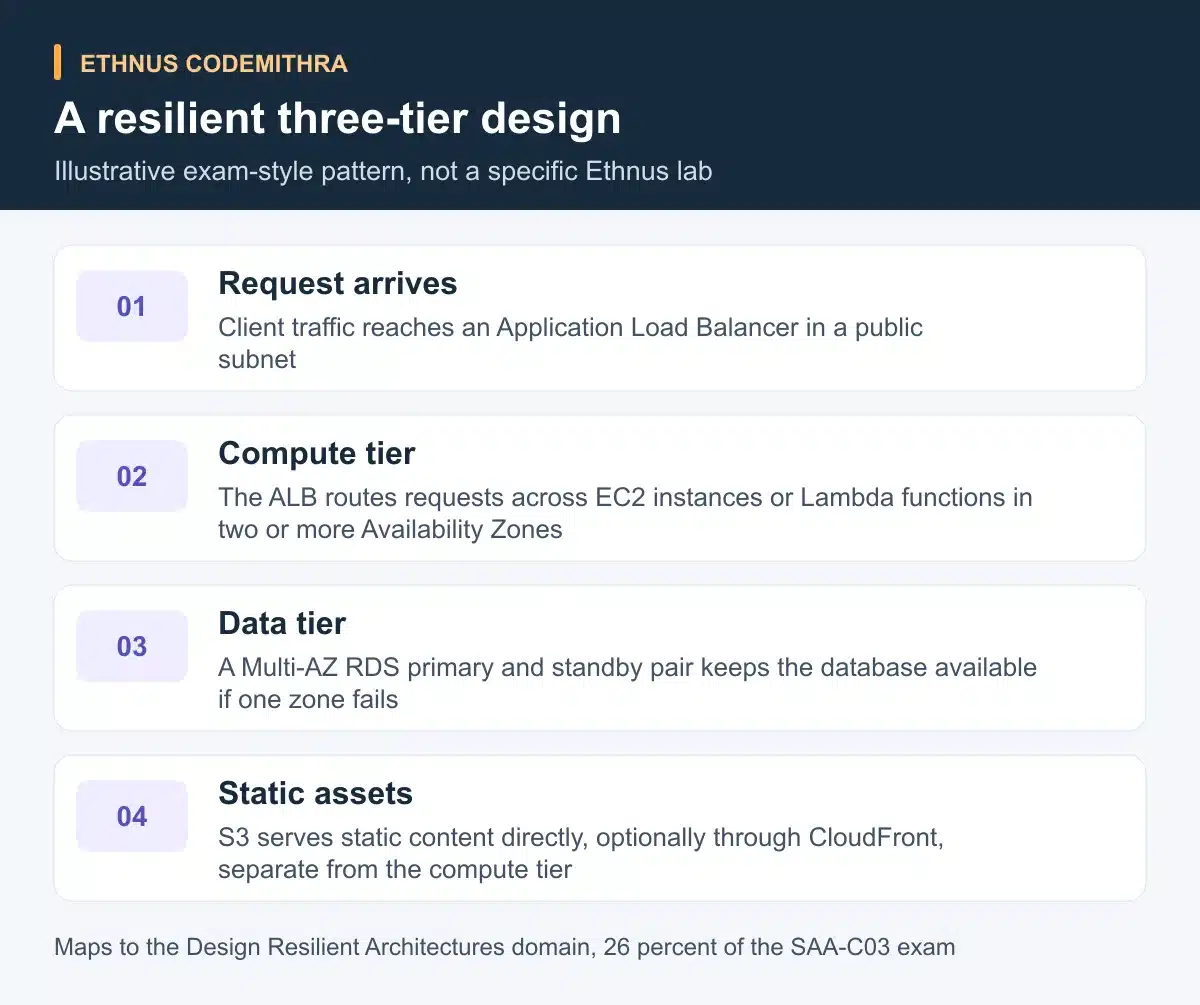
Each choice in this design maps to a reason. Multiple Availability Zones protect the compute tier. A standby database protects the data tier. A separate path protects static content from compute load. That reasoning, not the service names alone, is what the exam tests.
How this connects to Ethnus training
Codemithra's AWS Solutions Architect Associate course states that it prepares students for this exact exam, SAA-C03. Its syllabus groups topics under the same domain language AWS uses. Compute covers EC2 and Lambda. Storage covers EBS and S3. Networking covers VPC and Direct Connect. Security covers IAM and CloudTrail.
Databases cover RDS, ElastiCache and DynamoDB. The course also names design tracks for resilient, high-performing, secure and cost-optimised architectures. Its course page describes sandbox access with unlimited attempts for hands-on practice, and expert-led doubt-clearing sessions. If you have no cloud background yet, Codemithra's Cloud Practitioner Essentials course covers AWS fundamentals first.
Frequently asked questions
What does the AWS SAA-C03 exam actually validate?
It validates your ability to design solutions on AWS using the Well-Architected Framework. It also tests whether you can review an existing architecture and recommend improvements, according to the official exam guide. It is not a test of memorised service definitions alone.
How is the exam formatted, and what does it cost?
It has 65 questions, 50 scored and 15 unscored, in multiple-choice and multiple-response formats. There is no penalty for guessing. It runs for 130 minutes and costs 150 USD, per the AWS certification page, with possible regional pricing variation.
Do I need experience before attempting SAA-C03?
There is no formal prerequisite. AWS describes its target candidate as having at least one year of hands-on experience designing cloud solutions on AWS. Candidates without that background are pointed towards Cloud Practitioner first, per the exam guide.
How long does the certification stay valid?
Three years from the date you earn it, according to the AWS certification page.
What is the passing score?
Results are reported as a scaled score from 100 to 1,000. The minimum passing score is 720. Scoring is compensatory across the whole exam, not domain by domain, per the exam guide.
If this exam scope matches where you are heading, Codemithra's AWS Solutions Architect Associate course is the next step.