
A full stack developer works across the front end, the back end and the database of a web application. On the front end, the developer builds what the user sees and clicks. On the back end, the developer writes the server logic that processes a request. At the database layer, the developer stores and retrieves the data that logic needs. A full stack developer does not write every line alone on every project. The role means understanding each layer well enough to work in it when required.
Day to day, this means building interfaces and writing server logic. It also means querying the database, then testing across the layers. The skills needed include a front-end framework and a back-end language, plus a database and version control. This article breaks the role into its three layers. It lists the skills each layer needs, compares common stack combinations, and shows how Ethnus Codemithra's MERN Full Stack program maps onto that skill set.
The three layers, concretely
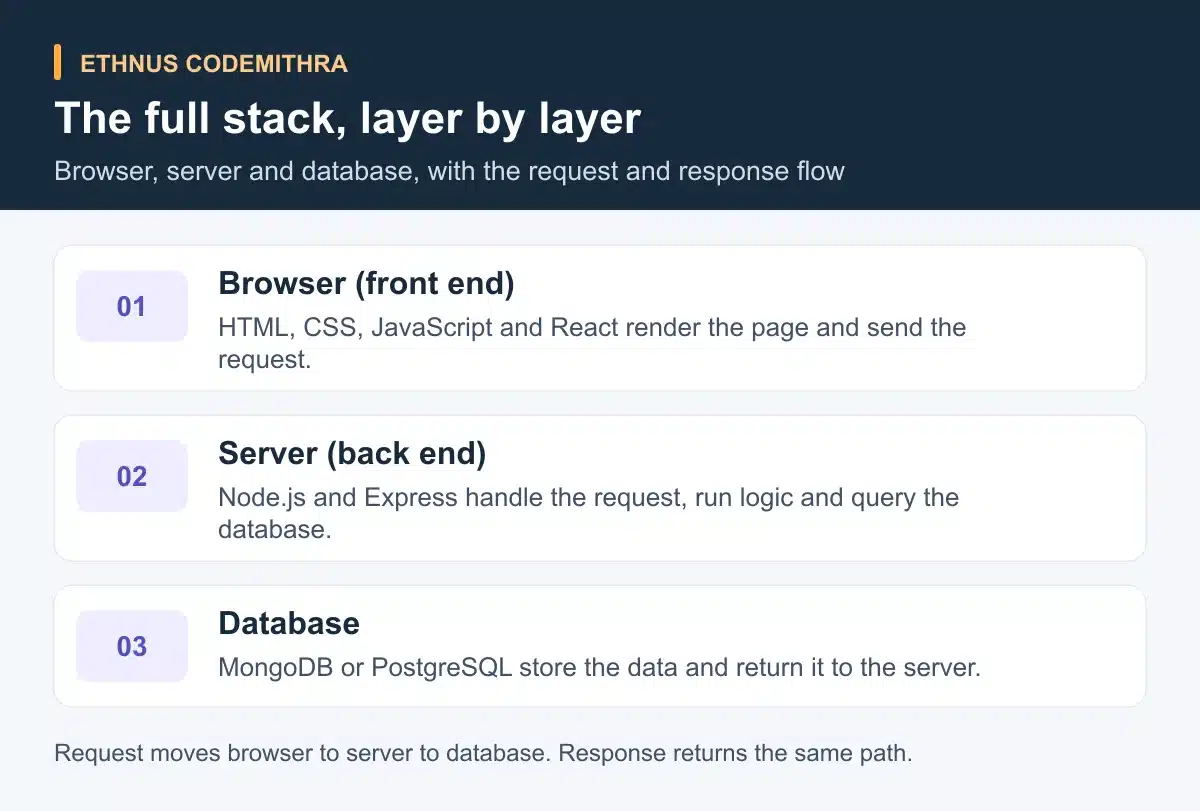
Front end, back end and database are not abstract categories. Each layer uses named tools, and a request passes through all three before a user sees a result.
The front end runs in the browser. HTML gives a page its structure. CSS controls how it looks. JavaScript adds behaviour. Most teams also use a front-end framework such as React, Angular or Vue.js to organise larger interfaces into reusable components.
The back end runs on a server. It receives the request the browser sends and decides what to do next. Node.js with the Express framework is one common choice for this layer. Python, Ruby, PHP and Java serve the same purpose in other stacks.
The database stores the data the back end reads or writes. MongoDB is a common NoSQL choice. MySQL and PostgreSQL are common relational choices. A full stack developer chooses between them based on how the application's data is shaped, not by default.
The diagram below shows how a request and its response move through the three layers.
Among professional developers who answered the 2025 Stack Overflow survey, Node.js led back-end use at 49.1 percent. React led front-end frameworks at 46.9 percent, ahead of Angular at 19.8 percent and Vue.js at 18.4 percent. Checked against the Stack Overflow Developer Survey 2025 on 8 September 2026. Treat this as a snapshot, not a permanent ranking, since framework use shifts year to year.
What a full stack developer actually does
Day to day work centres on a small set of recurring tasks, not one fixed job description. A full stack developer typically:
- Builds the user interface with HTML, CSS, JavaScript and a front-end framework.
- Designs the API that connects the front end to the back end.
- Writes server-side logic that validates input and calls the database.
- Sets up and queries the database, including its schema or document structure.
- Tests the application across its layers and fixes issues wherever they appear.
- Talks to designers and other developers about how a feature should work.
A full stack developer rarely spends equal time on every layer in a given week. Most spend more time on one layer and step into the others when a task needs it. The role is not about doing everything at once. It is about knowing each layer well enough to move between them without waiting on a handoff.
Skills that matter
The technical skill list for this role stays fairly stable. The specific tools shift more often.
- HTML, CSS and JavaScript, plus one front-end framework such as React, Angular or Vue.js.
- One back-end language and framework, for example Node.js with Express, or an equivalent in Python, Java, Ruby or PHP.
- Working knowledge of SQL for relational databases and at least one NoSQL database such as MongoDB.
- Git for version control, including branching and merging with a team.
- Enough deployment knowledge to get an application onto a server or a hosting platform.
Soft skills matter just as much, since a full stack developer works across teams. Clear communication helps when explaining a back-end constraint to a designer. Problem-solving ability matters because a bug can start in any layer, and finding it often means checking more than one.
Common stack combinations: a comparison you can use today
Before choosing what to learn, or which job posting to pursue, compare the stack a project uses against what it needs to do. The table below lists four combinations you will see often, with a typical use case for each.
| Stack | Front end | Back end | Database | Typical use case |
|---|---|---|---|---|
| MERN | React | Node.js, Express | MongoDB | General-purpose JavaScript full stack, fast prototyping |
| MEAN | Angular | Node.js, Express | MongoDB | Structured, enterprise-style front end on a JavaScript back end |
| LAMP | Server-rendered pages | PHP, Apache | MySQL | Traditional server-rendered sites and CMS-heavy work |
| Django + React | React | Django (Python) | PostgreSQL | Data or machine learning-adjacent back ends paired with a modern UI |
Try this now. Pick one job posting or one project idea you have in mind. Match it against the table above. If the posting names MongoDB and React, you are looking at a MERN-shaped role. If it names PHP and MySQL, expect LAMP-style work instead. This match tells you which language to prioritise first, rather than trying to learn every stack at once.
How people learn full stack development today
There is no single required path into the role. Some developers study computer science or a related degree, which gives broad grounding alongside practical coursework. Others teach themselves through documentation and project work, and build a portfolio that shows the same skills a degree would. A third path is a structured program that teaches the three layers together in sequence, with a trainer available to explain concepts and review code.
Each path can lead to the same outcome. What matters more than the path itself is whether you can point to working projects that use all three layers together. That is what the role actually asks for.
How Ethnus Codemithra's MERN full stack program fits in
If a structured program suits you, check what a course actually covers before enrolling. Ethnus Codemithra's MERN Full Stack program covers HTML5, CSS3 and Bootstrap. It also covers JavaScript, including ES6 and TypeScript, plus Node.js, Express.js and MongoDB, and now includes basics of Python and generative AI. Checked against the MERN Full Stack program page on 8 September 2026.
The class runs through trainer-led sessions, step-by-step walkthroughs, and quizzes, with access to the Codemithra Learning and Assessment Platform. Placement support consists of a resume building workshop, practice interviews, continuous placement opportunities and instant doubt clearing, as listed on the program page. These are the specific items the page names, not a general promise of career support.
Your interest may point more towards a Java back end than a JavaScript one. Ethnus Codemithra's JaWEsome program covers Java fundamentals, object-oriented programming and exception handling. It also covers multi-threading, collections, and HTML, CSS and JavaScript basics. It targets roles such as Java Developer and Backend Developer.
Frequently asked questions
What is a full stack developer?
A full stack developer works across the front end, back end and database layers of a web application. The developer can move between them as a project requires.
Do I need to master every layer equally?
No. Most full stack developers focus more time on one layer and use working knowledge of the others when a task needs it.
Which stack should I learn first?
Match a stack to what you want to build. MERN and MEAN suit general JavaScript projects. LAMP suits traditional server-rendered sites. Django with React suits data-heavy back ends with a modern front end.
Is React more important to learn than Angular or Vue.js?
React led usage among professional developers in the 2025 Stack Overflow survey. Angular and Vue.js remain active, current frameworks. Choose based on the stack a role or project actually uses.
What does the Ethnus Codemithra MERN full stack program cover?
It covers HTML5, CSS3, Bootstrap and JavaScript, including ES6 and TypeScript. It also covers Node.js, Express.js and MongoDB, with basics of Python and generative AI, taught through trainer-led sessions and the Codemithra Learning and Assessment Platform.
To see the full syllabus and how the program's trainer-led teaching and placement support fit together, visit the MERN Full Stack program page.