
Python is a general-purpose programming language known for readable syntax and a huge standard library. Its own maintainers describe it as "an interpreted, object-oriented, high-level programming language with dynamic semantics" (python.org). For a first language, it is a reasonable starting point for web backends, data work, automation or cloud scripting. It is a less direct route if your goal is a specific front-end or enterprise Java job from day one. The rest of this article explains why, with a comparison you can use today.
What Python actually is
Guido van Rossum created Python and began implementing it during the 1989 Christmas holidays, according to the official Python FAQ (docs.python.org). He first announced it publicly on USENET in February 1991. The language grew from that release into the general-purpose tool used across web development, data analysis and automation today.
One common myth is worth clearing up. Python is not named after the snake. Van Rossum named it after the BBC comedy series Monty Python's Flying Circus. He was reading its scripts while starting the project (docs.python.org). The snake logo came later, as a visual pun.
Python today: version and packaging
The current stable release is Python 3.14.7, published on 5 August 2026 (python.org). Python 3.14 receives bugfix and security updates through October 2030. Checked against the official python.org downloads page on 8 September 2026.
You do not need a separate install step for a package manager. pip ships with any current Python install through the built-in venv tool, a change in place since Python 3.4 (packaging.python.org). After you install Python, a command such as pip install requests adds a library without extra setup.
Python 2 is retired. It reached end of life on 1 January 2020, and its maintainers have not issued bug fixes or security updates since (python.org). An old tutorial with a print statement without brackets, or a function called raw_input(), is written for Python 2. It does not run as-is on the version you install today.
Why beginners gravitate to Python
Python reads close to plain English. A loop, a condition and a function definition use few symbols. A new student spends less time on punctuation and more time on logic. Compare that to C++, where a missing semicolon or type declaration stops the program before it runs.
Python's error messages, called tracebacks, point to the exact line and the type of mistake. This helps a beginner find a problem without decoding a wall of compiler output. The three lines below cover a print statement, a loop and a function, the three building blocks most tutorials start with.
print("Hello, World!")

fruits = ["mango", "guava", "papaya"]
for fruit in fruits:
    print(f"I like {fruit}")

def greet(name):
    return f"Hello, {name}!"

print(greet("Asha"))
Run this on your own machine with python3 hello.py after you install Python. Change the fruit list or the name passed to greet and rerun it. Seeing your own edit change the output is a better first lesson than reading about syntax.
Python vs JavaScript vs Java as a first language
None of these languages is universally "best". Each suits a different starting goal. Use the table below to match your own goal to a language before you commit weeks to one.
| Factor | Python | JavaScript | Java |
|---|---|---|---|
| Setup to run first program | Install Python, then run a single file | Open a browser console, no install needed | Install a JDK and set up a build tool first |
| Typical first project | A script, a small data task or a command-line tool | An interactive web page | A console app or an Android-style class exercise |
| Syntax verbosity | Low, few required symbols | Moderate, curly braces and semicolons | High, explicit types and class structure |
| Common next step | Data work, automation, or a backend framework such as Django or Flask | Front-end frameworks, then full stack work | Enterprise backend systems and Android development |
If your goal is a browser-based project on day one, JavaScript gets you there faster because it needs no separate install. If your goal is a job that expects strict typing and class structure, Java gives you that discipline early. If your goal is data work, automation or a general-purpose start, Python removes the most setup friction.
Python 2 vs Python 3, for context
Python 2 has been end of life since 1 January 2020 (python.org), so this table is historical context, not a live choice. It helps you recognise an outdated tutorial rather than follow one.
| Feature | Python 2 (retired) | Python 3 (current) |
|---|---|---|
print "text", a statement |
print("text"), a function |
|
| Reading input | raw_input() |
input() |
| Default string type | ASCII by default | Unicode by default |
| Range in a loop | xrange() |
range(), memory-efficient by default |
Should you learn Python first? A practical decision guide
Match the decision to your actual goal rather than to what is trending.
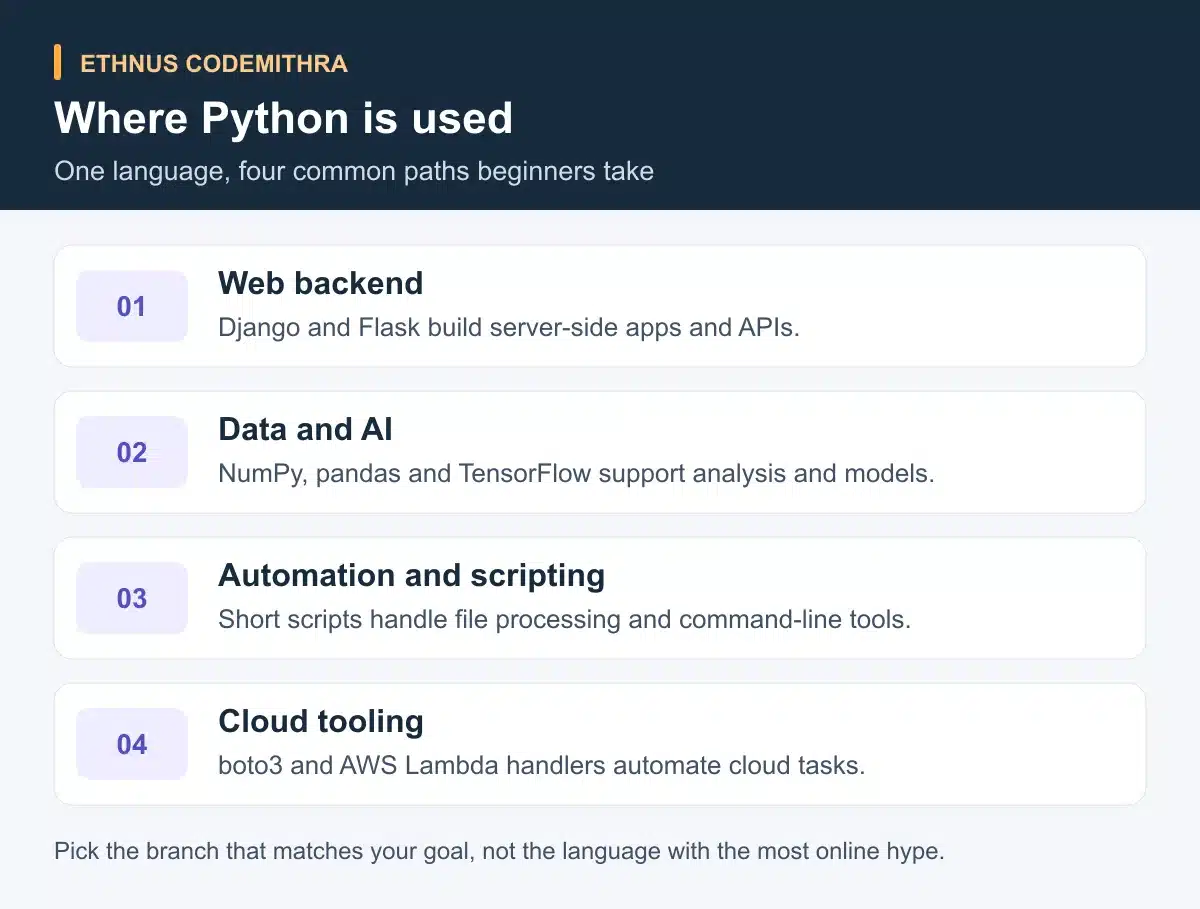
- You want to build a web backend or API: Python with Django or Flask is a direct route. The syntax stays readable as the project grows.
- You want to work with data or get into AI and machine learning: most data and AI libraries target Python first, including NumPy, pandas and TensorFlow.
- You want to automate repetitive tasks: Python's standard library covers file handling, scheduling and text processing without extra setup.
- You want a browser-based project immediately: start with JavaScript instead, since it runs in the browser with no install step.
- You want a job that expects strict, class-based structure from day one: Java gives you that discipline earlier than Python does.
As a general popularity signal, Python is currently ranked first on the TIOBE Index. Its rating is 17.76 percent as of September 2026 (tiobe.com). A high popularity ranking is not proof that Python fits your specific goal, so use the list above, not the ranking, to decide.
Where Python shows up in a Codemithra program
Codemithra does not run a standalone Python course. Its current catalogue lists programs such as AWS Solutions Architect Associate, MERN Full Stack, JaWEsome and Salesforce Developer. None of them is a dedicated Python program (codemithra.com/courses). Where Python does appear is inside the AWS Solutions Architect Associate program. Its curriculum highlights state it "now includes Basics of Python and Gen AI" alongside the core AWS architecture content. That program also includes lab and sandbox access with unlimited attempts on practical exercises, plus expert-led mentoring sessions with instant doubt clearing. A student who meets Python inside it gets to try the syntax in a hands-on lab, not only read about it. Ethnus, the training institution behind Codemithra, reached the milestone of mentoring over 5 lakh students across all its programs. This is a historical milestone spanning all its courses, not any single one (ethnus.com/about).
If cloud architecture with a Python component is your direction, start with the AWS Solutions Architect Associate program page. If you are still deciding between paths, browse the full Codemithra course catalogue before you commit.
Frequently asked questions
Is Python still worth learning in 2026?
Python remains ranked first on the TIOBE Index as of September 2026 (tiobe.com). It also stays the default choice for data, AI and automation work, so it remains a reasonable first language for those goals.
Do I need to install pip separately?
No. pip ships with any current Python install through the built-in venv tool, a change in place since Python 3.4 (packaging.python.org).
Should I learn Python 2 or Python 3?
Learn Python 3. Python 2 has been end of life since 1 January 2020 and no longer receives fixes or security updates (python.org).
Does Codemithra offer a dedicated Python course?
No. Codemithra's current catalogue has no standalone Python course. Python appears as a syllabus topic inside the AWS Solutions Architect Associate program (codemithra.com/courses).
Why is Python named Python if it is not about the snake?
Guido van Rossum named the language after the comedy series Monty Python's Flying Circus, not the snake (docs.python.org).