Becoming an AWS Solutions Architect is not one exam. Build core AWS skills, practise them hands-on, pass the AWS Certified Solutions Architect – Associate exam, then build real project experience a hiring manager can look at. The certification proves you know the services. The hands-on work and portfolio prove you can use them.
Build the core AWS skills first
Start with the services that appear in almost every architecture. That means compute (EC2, Lambda), storage (S3, EBS), networking (VPC, Route 53), databases (RDS, DynamoDB) and identity and access management (IAM). AWS sets the bar for the Associate exam at "at least 1 year of hands-on experience designing cloud solutions that use AWS services" (AWS Certified Solutions Architect – Associate exam guide). Treat that as a target, not a formality. A reader who only watches videos will recognise service names. That same reader will struggle with scenario questions that ask which combination of services fits a specific constraint.
The fastest way to close that gap is to build something small and break it on purpose. Change a security group, remove a permission, resize an instance, then watch what happens. That habit is what the next section covers.
Optional entry point: AWS Certified Cloud Practitioner
If you are new to cloud computing or IT, the AWS Certified Cloud Practitioner exam (current code CLF-C02) is a reasonable warm-up. It is not a requirement. It runs 65 questions in 90 minutes and costs 100 USD, less than the Associate exam. AWS suggests up to six months of AWS exposure without making it mandatory (AWS Certified Cloud Practitioner). Checked against the official AWS Certified Cloud Practitioner page on 8 September 2026.
Skip it if you already have hands-on AWS or general cloud background. It covers billing, support plans and high-level service categories. It does not cover the architecture depth the Associate exam tests, so it will not replace the skills work above.
Get hands-on before the exam
Labs and a sandbox account matter more than a second round of video lectures at this stage. Deploy a small application. Connect it to a database. Put it behind a load balancer, and lock down access with IAM roles instead of long-lived credentials. Then deliberately misconfigure one piece, read the error, and fix it. That habit, not memorised terminology, carries into scenario-based exam questions and real design reviews later.
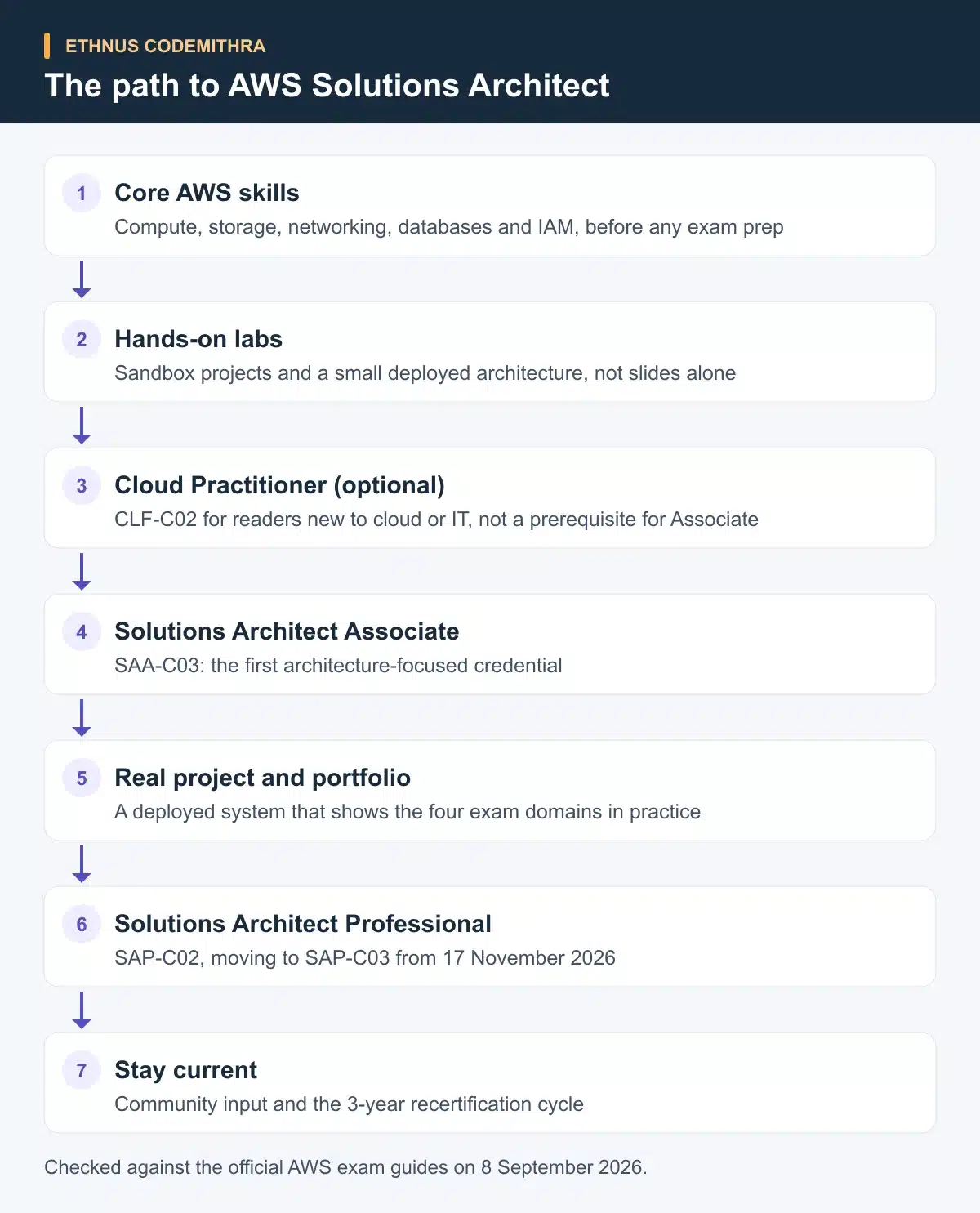
Try this today: a one-hour architecture exercise
Pick a small idea, such as a personal blog or a to-do list API. Sketch how you would host it on AWS using at least three services, for example S3 for static assets, Lambda or EC2 for logic, and DynamoDB or RDS for data. Write one sentence for each service explaining why you chose it over an alternative. This is a practice exercise for a free-tier account. It is not a claim that any specific Ethnus batch includes this exact task.
Earn AWS Certified Solutions Architect – Associate (SAA-C03)
The current version of the Associate exam is SAA-C03 (AWS Certified Solutions Architect – Associate exam guide). It has 65 total questions, 50 scored and 15 unscored, over 130 minutes, and costs 150 USD (AWS Certified Solutions Architect – Associate). The passing score is 720 out of a scaled 1,000. The certification stays valid for 3 years. Checked against the official AWS exam guide and pricing page on 8 September 2026.
Four domains make up the content outline. Design Secure Architectures is 30%, Design Resilient Architectures is 26%, Design High-Performing Architectures is 24%, and Design Cost-Optimized Architectures is 20% (exam guide). Study time should roughly follow those weights. Spend more time on security and resilience than on cost optimisation alone.
Build real project experience and a portfolio
The badge tells an employer you passed an exam. It does not show how you think through a design, and this is where most candidates stop too early. Build one or two small projects you can walk someone through end to end. Map each one back to an exam domain so the connection is obvious to a reviewer:
- A deployed multi-tier application. Front end on S3 or a container service, application logic on EC2 or Lambda, data in RDS or DynamoDB. Shows secure and resilient architecture in practice.
- A cost-optimisation write-up. Take an existing design, yours or a public reference architecture. Document three changes that would reduce cost without breaking functionality, such as Spot instances for non-critical work or a lifecycle policy on S3. Shows the cost-optimised domain.
- A resilience exercise. Deliberately take down one component, such as stopping an instance or deleting a security group rule. Document how the system degraded and what you changed to reduce that impact next time. Shows the resilient-architecture domain.
Document each project in a short write-up: what you built, why you chose each service, and one thing that broke. Add how you fixed it. That last part matters more than a polished diagram, because it is the part an interviewer actually asks about.
Level up to AWS Certified Solutions Architect – Professional
The Professional exam sits above Associate. It currently runs as SAP-C02 (AWS Certified Solutions Architect – Professional exam guide). AWS recommends 2 or more years of experience using AWS services to design and implement cloud solutions before attempting it. That is roughly double the Associate benchmark.
| Detail | Associate (SAA-C03) | Professional (SAP-C02) |
|---|---|---|
| Recommended experience | 1+ year hands-on with AWS | 2+ years hands-on with AWS |
| Questions | 65 total (50 scored, 15 unscored) | 75 total (65 scored, 10 unscored) |
| Duration | 130 minutes | 180 minutes |
| Price | 150 USD | 300 USD |
| Passing score | 720 out of 1,000 | 750 out of 1,000 |
| Validity | 3 years | 3 years |
Sources: SAA-C03 exam guide, SAA-C03 exam page, SAP-C02 exam guide, SAP-C02 exam page. Checked 8 September 2026.
The Professional content outline weights four domains. Design Solutions for Organizational Complexity is 26%, Design for New Solutions is 29%, Continuous Improvement for Existing Solutions is 25%, and Accelerate Workload Migration and Modernization is 20% (SAP-C02 exam guide).
This is a live transition to watch. AWS has confirmed that SAP-C02 retires on 16 November 2026. SAP-C03 registration opens 27 October 2026, and SAP-C03 becomes generally available on 17 November 2026 (AWS Training and Certification blog, September 2026). SAP-C03 is announced to add generative AI content covering Amazon Bedrock and AgentCore, plus resilience, DevSecOps, data lakehouse and post-quantum cryptography skill areas. The format stays the same: 75 questions, 180 minutes, 300 USD. AWS has not yet published SAP-C03 domain weightings. Check the official exam guide before booking a seat close to that date.
Stay current and keep learning
Both certifications expire after 3 years. Recertification is a recurring part of the role, not a one-time event (AWS Certified Solutions Architect – Associate, AWS Certified Solutions Architect – Professional). Beyond the recert clock, AWS revises services and exam content on its own schedule, as the SAP-C02 to SAP-C03 transition shows. Read AWS's own announcements before a scheduled exam date. Join a forum or local user group to hear about changes early. Keep at least one small project running so your hands-on skills do not go stale between recert cycles.
How Ethnus training maps to each step
For the optional entry step, the Cloud Practitioner Essentials course runs 50+ hours of Cloud Practitioner content plus a 250+ hour Basic Essentials course. It has 11 modules, including basics of Python and generative AI, with sandbox access and step-by-step lab walkthroughs.
For the certification and hands-on stages together, the AWS Solutions Architect Associate course targets the SAA-C03 exam directly. It runs 150+ hours of AWS architecting plus a 250+ hour Basic Essentials course. Its syllabus is organised around the same four domains the exam uses, secure, resilient, high-performing and cost-optimised architectures. The course includes sandbox access with unlimited lab attempts and trainer-led doubt-clearing sessions. Placement support adds a resume-building workshop and practice interviews, and lists hiring partners including IBM, L&T, HP, Tech Mahindra and HCL.
Want a short taster before committing to a full course? The AWS Cloud Masterclass is a 3-hour live session covering cloud fundamentals and a hands-on facial-recognition build. It closes with a certification and next-steps module. Students earn a certificate and badge from Ethnus and NASSCOM FutureSkills after a post-session assessment.
Frequently asked questions
Do I need Cloud Practitioner before Solutions Architect Associate?
No. AWS does not list Cloud Practitioner as a prerequisite for the Associate exam. It is a useful warm-up if you are new to cloud or IT. If you already have hands-on AWS experience, go straight to Associate-level preparation.
How much AWS experience do I need for Associate versus Professional?
AWS recommends at least 1 year of hands-on experience for the Associate exam. Professional asks for 2 or more years of experience using AWS services to design and implement cloud solutions (SAA-C03 exam guide, SAP-C02 exam guide). These are AWS's stated target-candidate guidelines, not strict eligibility requirements.
What happens to SAP-C02 after November 2026?
AWS has set 16 November 2026 as the last day to sit SAP-C02. SAP-C03 registration opens 27 October 2026, and SAP-C03 goes generally available on 17 November 2026 (AWS Training and Certification blog). If your target date is close to that window, check the official exam guide before booking.
What should my portfolio actually contain?
Two or three small, documented projects beat one polished demo with no write-up. Map each project to an exam domain: security, resilience, performance or cost. Be ready to explain one thing that broke and how you fixed it.
Is the Professional certification worth it if I already have Associate?
That depends on your role and experience level. What this article can state is the format difference. Professional has more questions, runs longer, costs twice as much, and expects roughly double the hands-on experience of Associate. Use that gap to judge whether you are ready, rather than a fixed rule.
Start with the step that matches where you are today. New to cloud? Start with Cloud Practitioner Essentials. Already have hands-on AWS experience and want structured labs and trainer support toward SAA-C03? Look at the AWS Solutions Architect Associate course.