
A career in AWS is worth pursuing for most technology freshers. A certification alone does not prove you can do the job. It proves you passed one proctored exam on one date. Global cloud infrastructure spending reached $143 billion in the second quarter of 2026, up about 43% year on year (Synergy Research Group, reported August 2026). AWS held the largest single share at 28%. Microsoft Azure and Google Cloud grew faster off smaller bases, mostly on AI workload demand. That is the honest starting point. AWS is not shrinking, but it is not the runaway "fastest-growing" story that older blog posts once claimed. The real question for a fresher is narrower: what does an AWS certification actually get you, and where should you start.
What an AWS certification proves, and what it does not
AWS training prepares you for an exam. It does not award the credential by itself. You earn a certification only after a passing score on a proctored exam. The digital badge you receive afterwards, issued through Credly, shows the exam name and the date you passed it. It does not show which course or trainer you used (AWS Certification FAQ).
Every certification page also lists "recommended experience", such as "1 or more years" for an associate-level exam. Read that as guidance for how ready you are likely to feel. It is not an entry requirement. AWS sets no formal prerequisite for who may register and sit any of its exams. A fresher with strong lab practice can attempt the same exam as someone with years on the job.
None of this makes a certification worthless. It answers one specific question: did you pass this exam on this date. It leaves other questions for interviews and projects to answer, such as whether you can debug a real production issue.
The current AWS certification map
AWS certifications sit at three levels: foundational, associate and professional, plus a small number of specialty exams. Checked against the official AWS certification pages on 8 September 2026.
| Certification | Exam code | Level | Recommended experience | Validity |
|---|---|---|---|---|
| Cloud Practitioner | CLF-C02 | Foundational | About 6 months of AWS exposure | 3 years |
| AI Practitioner | AIF-C01 | Foundational | Familiarity with AI, ML and generative AI concepts | 3 years |
| Solutions Architect Associate | SAA-C03 | Associate | 1+ year of hands-on solution design | 3 years |
| Developer Associate | DVA-C02 | Associate | 1+ year developing on AWS | 3 years |
| Machine Learning Engineer Associate | MLA-C01 | Associate | 1+ year with SageMaker and ML engineering services | 3 years |
| Solutions Architect Professional | SAP-C02 | Professional | 2+ years designing on AWS | 3 years |
| DevOps Engineer Professional | DOP-C02 | Professional | 2+ years operating AWS environments | 3 years |
| Generative AI Developer Professional | AIP-C01 | Professional | 2+ years on AWS plus 1+ year with generative AI | 3 years |
Two notes on codes that change. The Solutions Architect Professional exam runs as SAP-C02 today. SAP-C03 registration opens 27 October 2026. The Developer Associate exam runs as DVA-C02, with DVA-C03 registration opening the same date. Recheck the exam code before you register close to that date.
One exam is on its way out rather than in. AWS Certified Machine Learning Specialty stops accepting new candidates after 31 March 2026. Anyone who already holds it keeps it active for 3 years from the date they earned it. Do not plan a fresh study path around it. Machine Learning Engineer Associate (MLA-C01) now covers similar ground at the associate level.
Where does a fresher actually start
Most freshers fall into one of two starting positions, and each points to a different first exam.
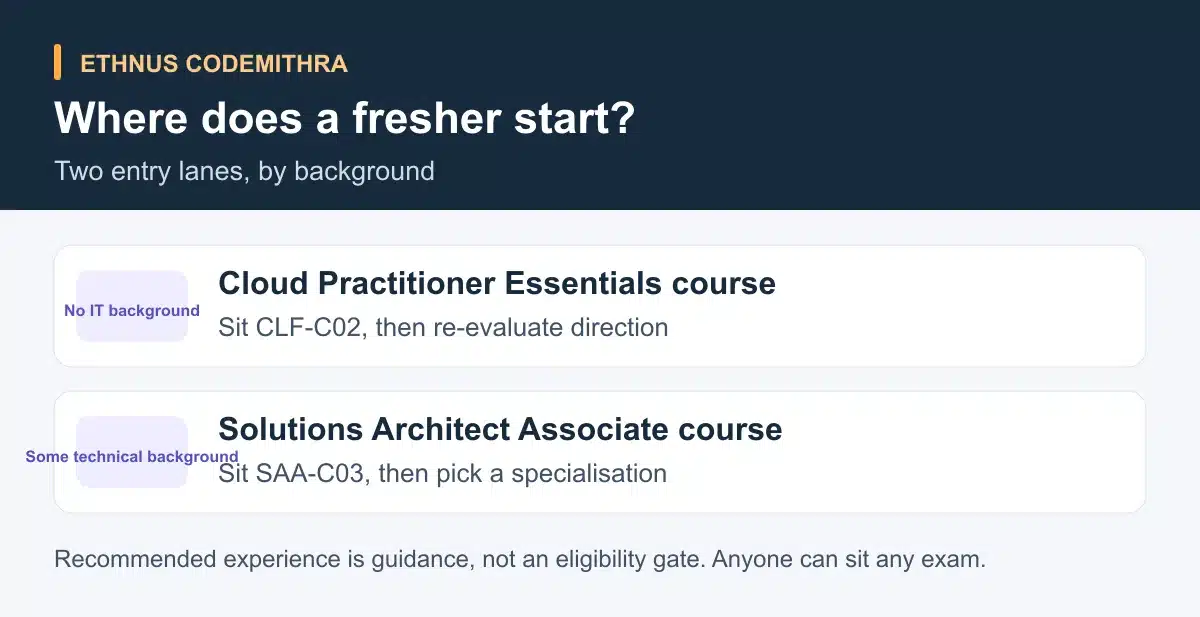
If you have no prior IT background, start with Cloud Practitioner (CLF-C02). It covers cloud concepts, core AWS services, security basics and support, at a level that assumes no prior hands-on work. Passing it tells you, honestly, whether cloud computing is worth pursuing further before you invest in a longer associate-level course.
If you already have some technical background, such as a computer science degree, you can go straight to Solutions Architect Associate (SAA-C03). AWS does not require the foundational exam first. From there, a specialisation becomes the next realistic step: Developer Associate, DevOps Engineer Professional, ML Engineer Associate or Generative AI Developer Professional, chosen by the work you want to do.
A badge from either path tells an interviewer you understand the vocabulary. It shows you passed a timed exam under proctored conditions. It does not show them a working project. Pair the exam with at least one thing you built and can explain.
A decision you can make today
Before you register for anything, write down two lists on paper. First, list what you have already used hands-on: a Linux terminal, Git, a scripting language, a database. Second, list what your target job description actually asks for, such as infrastructure design or machine learning. If list one is short, start at Cloud Practitioner. If list two names a specific role, let that pick your first associate-level exam, rather than choosing the most talked-about one.
How Ethnus's AWS courses fit this path
Ethnus Codemithra runs two AWS courses that map onto the two entry lanes above. The AWS Cloud Practitioner Essentials course carries more than 50 hours of dedicated content inside a combined course of 250-plus hours. It runs across 11 sections that follow the exam's own scope, from AWS basics and networking through to the Well-Architected Framework. It suits the no-background starting point in the decision above.
The AWS Solutions Architect Associate course is a 4-week course of about 320 hours. It is built around the SAA-C03 domains. Topics include core services such as EC2, Lambda, S3, VPC and IAM, resilient and cost-optimised architecture design, plus Java and Python basics. The course page describes lab and sandbox access with unlimited attempts, trainer-led support sessions, a resume-building workshop and practice interviews. Neither course page states a placement percentage or a guarantee, so treat that support as preparation rather than an outcome promise.
Ethnus also runs the separate AWS Cloud Masterclass, a 3-hour session that includes a guided facial-recognition build. Scoring 60% or above, with up to 3 attempts, earns a joint certificate and badge from Ethnus and NASSCOM FutureSkills. That certificate belongs to this short session, not to the longer Solutions Architect Associate course. Keep the two apart when you compare what each one gives you. Ethnus reached the milestone of training over 5 lakh students across all its courses (Ethnus, about page). That figure is company-wide, not AWS-specific.
Bottom line
An AWS career is a reasonable bet for a fresher, given current, sourced cloud-spend growth. No course page or article can honestly promise a salary, a job or a placement rate. None of the sources checked for this article state one. Pick your entry exam by your actual background rather than by hype. Treat the badge as one verifiable data point among several. Pair it with a small project you can walk an interviewer through before you call yourself interview-ready.
Frequently asked questions
Do I need Cloud Practitioner before Solutions Architect Associate?
No. AWS sets no requirement to pass Cloud Practitioner first. Some technical background makes Solutions Architect Associate (SAA-C03) manageable as a first exam.
Does a badge prove I can get a job?
No. A badge shows the exam name and pass date through Credly. It does not show a trainer, a placement outcome or hands-on project work on its own (AWS Certification FAQ).
Is AWS Certified Machine Learning Specialty still worth studying for?
Only if you already planned to sit it before 31 March 2026, its last exam date. New study plans should target Machine Learning Engineer Associate (MLA-C01) instead.
Is the Ethnus Cloud Masterclass the same certificate as the Solutions Architect Associate course?
No. The Cloud Masterclass is a separate 3-hour session with its own joint Ethnus and NASSCOM FutureSkills certificate, distinct from the longer architecture course.
Compare your background against the two entry lanes above, then start with AWS Cloud Practitioner Essentials if you are new to IT, or the AWS Solutions Architect Associate course if you already have technical footing.