
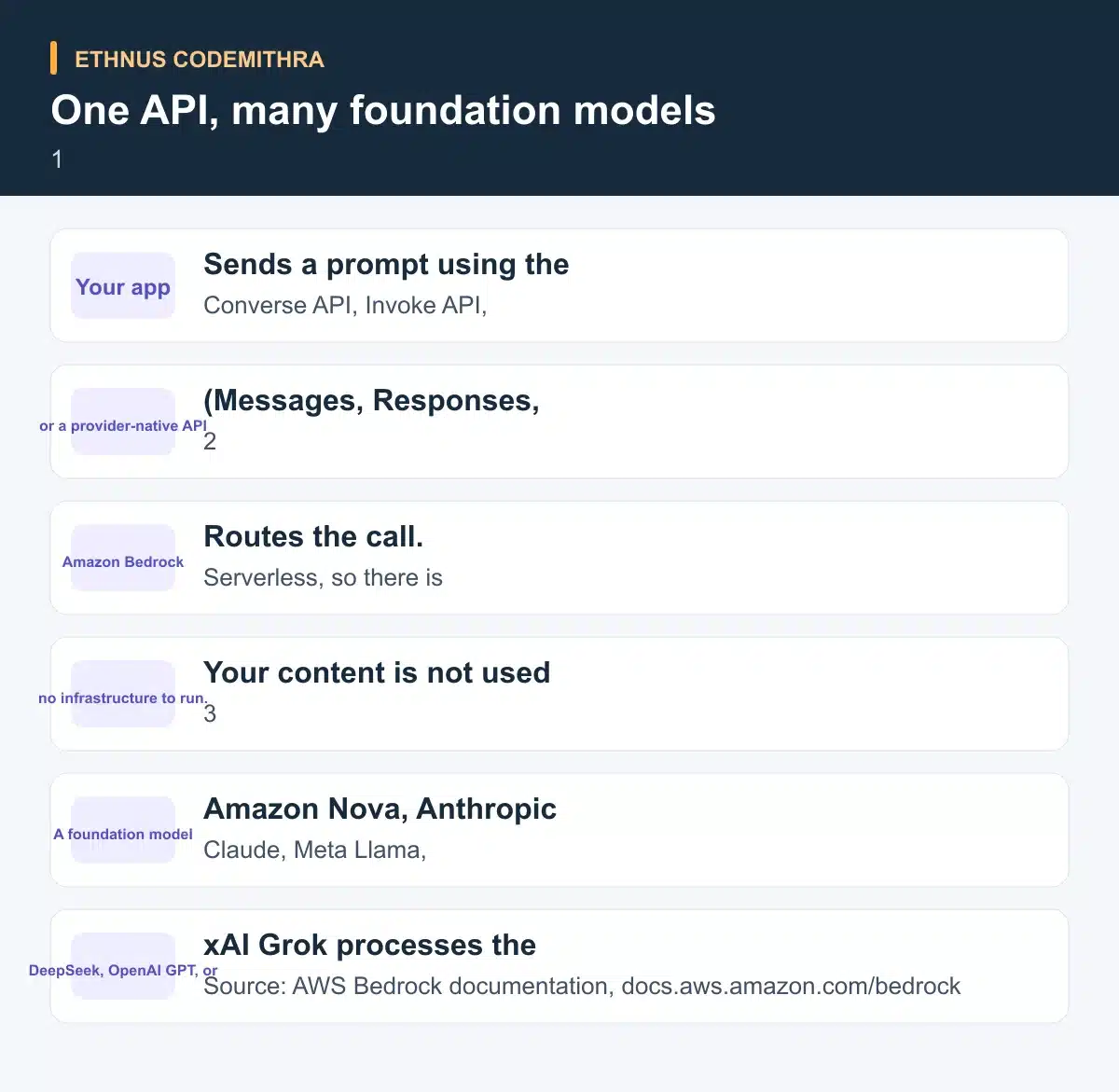
Amazon Bedrock is a fully managed service that gives you access to more than 100 foundation models. Its providers include Amazon, Anthropic, DeepSeek, Moonshot AI, MiniMax, OpenAI and xAI. All of them sit behind one platform and one AWS bill (AWS documentation). The difference from calling OpenAI or Gemini directly is not the model quality. Bedrock puts many vendors' models behind a shared set of APIs and a single AWS account. That replaces a separate account, key and bill for each provider.
Checked against the official AWS documentation on 8 September 2026.
What Amazon Bedrock actually is
AWS describes Bedrock as "a fully managed service that provides secure, enterprise-grade access to high-performing foundation models from leading AI companies" (AWS documentation). Bedrock does not build these models itself. It hosts models trained by other companies. You call them through AWS infrastructure, using your existing AWS account and IAM permissions.
Because it is serverless, you do not provision or manage any servers to run the models (Amazon Bedrock FAQs). You send a request, a model processes it, and you get a response back, billed by usage.
What a foundation model is, in plain terms
A foundation model is a large model trained on broad data, usually text. A provider builds it once, then makes it available for many tasks: answering questions, writing text, summarising documents or generating code.
Anthropic trains Claude. OpenAI trains its GPT models. Meta trains Llama. Amazon trains its own Nova models. Each provider trains and controls its models directly. Bedrock only hosts and serves them.
This is why the term "foundation model" is broader than "chatbot". The same underlying model can power a chat interface, a document summariser or a coding assistant. It depends on how a developer calls it.
Why this matters now: openAI joined the roster
Bedrock's current lineup spans Amazon Nova, Anthropic Claude, DeepSeek, Moonshot AI's Kimi, MiniMax, OpenAI and xAI's Grok (AWS documentation). AWS states that OpenAI models are "now generally available" on Bedrock alongside Anthropic, Meta and Amazon's own models (Amazon Bedrock overview). GPT-5.5, GPT-5.4 and Codex from OpenAI reached general availability on Bedrock in June 2026 (AWS announcement). GPT-5.6 Sol, Terra and Luna followed in July 2026 (AWS announcement).
This detail dates most older "what is Bedrock" tutorials, which describe it as an Amazon-and-Anthropic-only service. A guide written before mid-2026 will not mention OpenAI models on Bedrock at all.
Bedrock versus calling a provider's API directly
The reader question behind this article is fair. If you can already call the OpenAI API or the Gemini API directly, what does Bedrock add? The table below sets out the practical differences.
| Aspect | Amazon Bedrock | Calling a provider's API directly |
|---|---|---|
| Accounts and keys | One AWS account and one set of IAM credentials for every supported provider | A separate account and API key per vendor |
| Billing | Usage from all providers appears on one AWS bill | A separate invoice from each vendor you use |
| Model catalogue | 100+ models across Amazon, Anthropic, DeepSeek, Moonshot AI, MiniMax, OpenAI and xAI in one console (AWS documentation) | Only the models that one vendor offers |
| Data-handling stance | AWS states customer content "is not used to improve the base models and is not shared with any model providers" (Amazon Bedrock FAQs) | Varies by vendor. Check each provider's own policy, since no blanket claim applies |
| Added tooling | Knowledge Bases for retrieval, fine-tuning and customisation, Guardrails, and AgentCore for agents, inside the same platform | You build or integrate this tooling yourself |
| Best fit | Teams already standardised on AWS accounts and IAM who want several providers behind one interface | Teams that need a specific model Bedrock does not carry, such as Google Gemini |
That last row matters. Bedrock's supported-provider list does not include Google, so it is not a universal replacement for calling a vendor's API directly. It is a way to standardise on one platform for the providers it does carry.
What comes with Bedrock beyond a single model call
Bedrock includes tools most raw API calls do not give you. Knowledge Bases add retrieval-augmented generation, so a model can answer from your own documents. Bedrock also supports model customisation through fine-tuning, continued pre-training and distillation (Amazon Bedrock overview).
Bedrock Guardrails is a separate content-safety layer. AWS's own product page states Guardrails can "block up to 88% of harmful content". It also describes validation-decision explanations as "99%" accurate (Amazon Bedrock Guardrails). AWS does not publish the methodology behind either figure, so treat them as the vendor's own marketing numbers rather than an independently audited result.
For building agents, AWS offers Amazon Bedrock AgentCore. AWS describes it as "the end-to-end platform to build, connect and optimize highly capable agents securely, at scale" (Amazon Bedrock overview). AgentCore is worth knowing about, but it comes with a limit. The AWS Free Tier page lists it as "Paid plan exclusive". Plain Bedrock model access, by contrast, is available on both plans (AWS Free Tier). A beginner working from a free or credit-funded account cannot use AgentCore yet.
Getting model access today
Older Bedrock tutorials show a manual "request access" screen for every model, with an approval wait. That is no longer how most models work. AWS's current documentation states that "access to all Amazon Bedrock foundation models is enabled by default with the correct AWS Marketplace permissions". Bedrock "automatically initiates the subscription process in the background" the first time you invoke a third-party model (Request access to models).
Anthropic models are the exception. You must complete a one-time "First Time Use" form describing your use case before invoking a Claude model. This does not apply if you access the model through the separate bedrock-mantle endpoint (Request access to models). If you do not run a company, the form accepts a personal project or portfolio link instead.
What it costs to try
Bedrock has no built-in free tier for specific models. Pricing is pay-per-token on demand by default, and every call is billed from the first token (Amazon Bedrock pricing). Provisioned throughput, batch processing and Standard, Flex, Priority and Reserved service tiers are available as options. No model in the catalogue is labelled "free tier eligible".
What funds a beginner's first experiments is the account, not the service. A new AWS account can get up to $200 in promotional credit over a six-month account window (AWS Free Tier). That is $100 immediately at sign-up, plus up to $100 more by using services such as Amazon EC2 and Amazon Bedrock. That credit pays for your test calls. It does not make Bedrock permanently free, and usage is still metered against it.
A practical exercise you can run today
Open the Bedrock console's model catalogue and pick two or three available models from different providers. For example, try one Amazon Nova model and one Anthropic Claude model. Send the identical prompt to each one in the playground and compare the tone, length and structure of the responses. Pay attention to how each provider's answer differs even though the question was the same word for word.
Run this against your account's new-customer credit, not a permanent free allotment. Check the console's usage screen afterwards, so you know what each test consumed. If a model needs the Anthropic use-case form, submit it with a short description of this exercise before your first Claude call.
Where this fits an Ethnus learning path
Ethnus Codemithra's AWS Cloud Practitioner Essentials course now includes basics of Python and generative AI as part of its curriculum (AWS Cloud Practitioner Essentials). That sits alongside the course's core cloud fundamentals sections. It is a reasonable starting point before a hands-on Bedrock tutorial. It builds cloud concepts and lab skills a beginner needs first.
The course lists ample labs and sandbox access with step-by-step walkthroughs and unlimited attempts (AWS Cloud Practitioner Essentials). It also lists placement support activities such as a resume building workshop, practice interviews and continuous placement opportunities. This article does not claim that course teaches Bedrock by name. It covers the Gen AI and Python basics that come before a Bedrock-specific lesson.
Frequently asked questions
Is Amazon Bedrock the same as ChatGPT or Claude?
No. Bedrock is the platform that hosts and serves models such as Claude and, since 2026, OpenAI's GPT models. It does not replace the chat apps those companies publish. It lets developers call the underlying models through AWS.
Does Bedrock include Google Gemini?
No. Bedrock's supported providers are Amazon, Anthropic, DeepSeek, Moonshot AI, MiniMax, OpenAI and xAI (AWS documentation). Gemini is not on that list, so a team that needs Gemini specifically must call Google's API directly.
Do I need to request access before using any Bedrock model?
Not for most models. Access is enabled by default given the correct Marketplace permissions, and Bedrock subscribes you automatically on first invoke. Anthropic models still need a one-time use-case form first (Request access to models).
Is there a free tier for Bedrock models?
No model is labelled free tier eligible. Every call is billed by token from the start. New AWS accounts can get up to $200 in promotional credit over six months (AWS Free Tier). That credit covers a beginner's first tests.
Can I use Bedrock AgentCore on a free account?
No. AgentCore is listed as a paid-plan-exclusive capability, separate from plain Bedrock model access, which is available on both plans (AWS Free Tier).
Start with the cloud fundamentals that make services like Bedrock make sense: explore Ethnus Codemithra's AWS Cloud Practitioner Essentials program.