
To become a full stack developer, learn the front end, then the back end, then a database, then deployment. You are ready to apply once you build one project across every layer. You should also deploy it and explain it. This guide sets out the skill checklist behind each step. It also includes a diagram of how the layers connect and the one-project readiness test. A comparison of course paths closes the guide.
What a full stack developer actually does
A full stack developer works across three layers of a web application. The front end is what a user sees and clicks. It uses HTML, CSS and JavaScript, usually through a framework such as React, Angular or Vue. The back end runs the server logic behind the scenes. It receives requests, applies business rules and talks to a database. The database stores and returns data, using a SQL system such as PostgreSQL or a NoSQL system such as MongoDB.
Being full stack does not mean mastering every tool in each layer. It means you understand how the three layers pass information to each other. That understanding lets you build a working feature end to end, and debug it when something breaks.
How a request moves through the full stack
The diagram below shows one round trip through the stack. A user acts in the browser, the action reaches the back end, the back end talks to the database, and the result returns to the screen. Every full stack feature you build follows this same cycle, whatever technologies you use.
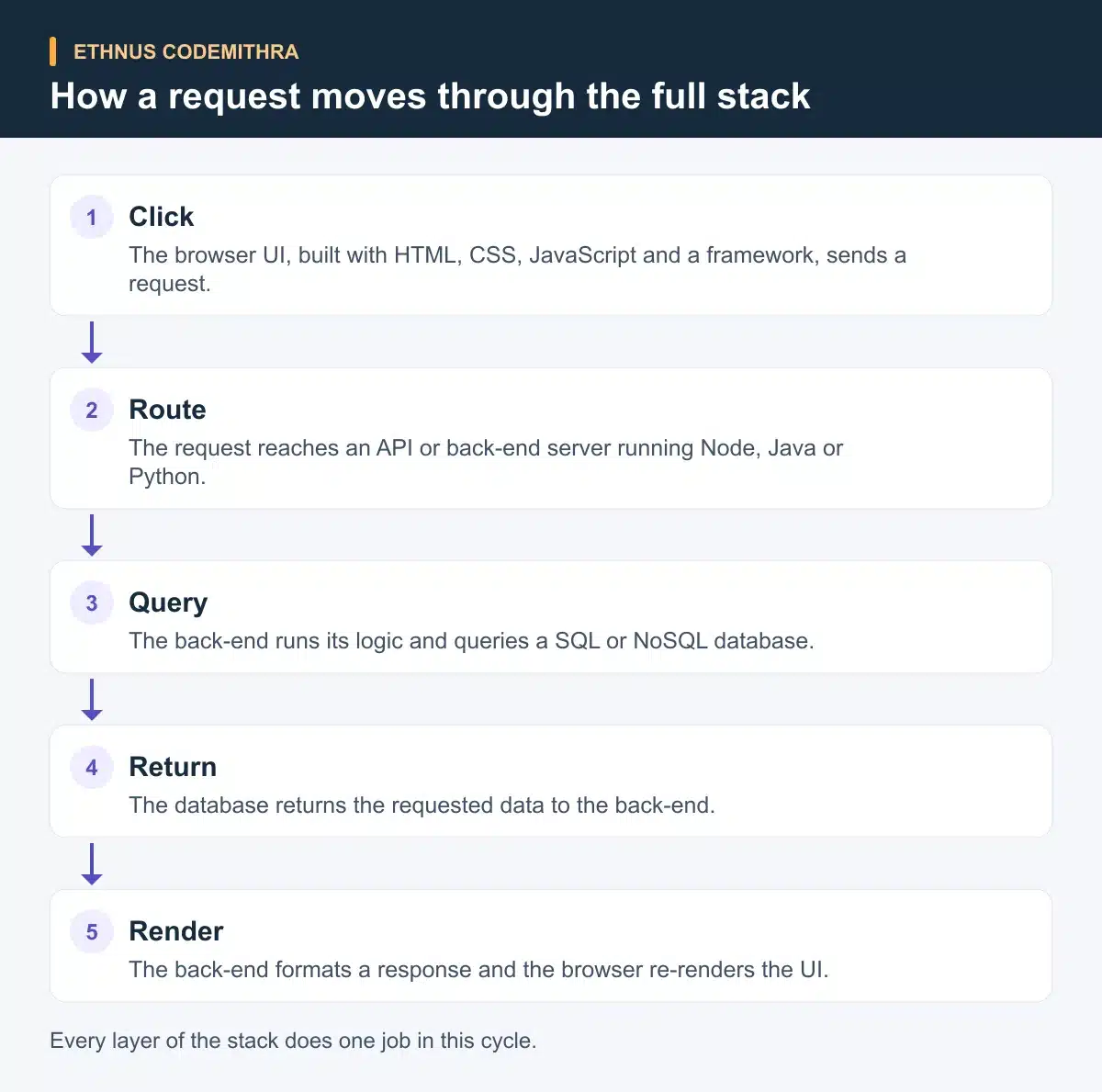
Point to each of these five steps in a project you built yourself. Explain what happens at each step in plain words. If you can do that, you understand the stack. If you can only point to the front end, or only to the back end, you have a gap to close before that test passes.
The core skill checklist
Use this list to check your own progress rather than as a strict sequence. Most students learn several of these areas at the same time.
- Front end: HTML and CSS for structure and styling, JavaScript for behaviour, and one framework such as React, Angular or Vue.
- Back end: one server language such as Node.js, Java or Python, plus the ability to build an API that the front end can call.
- Database: one SQL system, such as PostgreSQL or MySQL, and one NoSQL system, such as MongoDB.
- Version control: Git, used daily to track changes and work with a team.
- Deployment awareness: basic CI/CD concepts and one cloud platform, enough to get an application from your machine onto the internet.
None of these need to be perfect before you apply for a role. Employers look for a working understanding of each layer, not expert depth in all of them at once.
Know when you are ready to apply
The clearest readiness signal is not a list of finished tutorials. It is a single project you designed, built and deployed yourself, one you can explain without notes. Pick something small, such as a to-do list with user accounts or a booking form. Build the front end, write the back-end API, connect a database, then deploy it somewhere a stranger can open in a browser. Trace the request through every step in the diagram above and explain each one out loud.
There is no single honest number for how long this takes, since it depends on your starting point and the hours you commit each week. A structured course gives a clearer anchor. JaWEsome runs 160+ hours across 4 weeks, a concrete reference point against a self-paced plan (JaWEsome). Rather than aim at a fixed date, use the project test above as your finish line, whatever the calendar says.
Which path fits you
Two Codemithra courses turn the checklist above into a structured course. JaWEsome is a Java-first route that builds on core Java and object-oriented programming before adding web basics, with exposure to AWS, cybersecurity, Salesforce and MERN full stack. MERN Full Stack is a JavaScript-first route built around MongoDB, ExpressJS, React and NodeJS, with some Java and Python basics included. Read the syllabus and current duration on each course page before you choose (JaWEsome, MERN Full Stack).
Where Ethnus Codemithra fits
If a structured course suits you better than self-study, Ethnus Codemithra runs two full stack courses that match the paths above. The MERN Full Stack course covers HTML5, CSS3, Bootstrap, JavaScript including ES6 and TypeScript, MongoDB, ExpressJS, React and NodeJS. It also includes Java fundamentals and the basics of Python and Gen AI. Trainers run expert-led sessions with step-by-step walkthroughs and instant doubt clearing, and the course ends with a course completion certificate from Ethnus Codemithra.
JaWEsome, short for Java and Web Essentials, runs over 160+ hours across 4 weeks. It covers Java fundamentals, object-oriented programming, exception handling, multithreading and collections, HTML, CSS and JavaScript, DBMS and operating systems. Students also get exposure to AWS, cybersecurity, Salesforce and MERN full stack. The course uses the Codemithra Learning and Assessment Platform for module-based assignments, and it too ends with a certificate of course completion issued by Ethnus Codemithra. Both courses offer placement assistance, including a resume building workshop and practice interviews, rather than a placement guarantee.
Ethnus has mentored over 5 lakh students across all its courses, a total built up over the years rather than a count for one specific course (Ethnus about page).
Conclusion
Readiness for a full stack role is not a fixed number of months. It is not a finished list of tutorials either. It is the ability to build, deploy and explain one project that moves through every layer of the stack shown in the diagram above. Use the skill checklist to spot gaps, and use the shipped project as your actual test.
If you want that skill checklist built for you through a structured program, compare the MERN Full Stack course against JaWEsome. Choose based on whether you want a JavaScript-first or Java-first starting point.
Frequently asked questions
What does a full stack developer actually do day to day?
A full stack developer builds and maintains the front end a user sees. They also write the back-end logic that processes requests, and manage the database that stores data, moving between all three as a feature requires.
Do I need a computer science degree to become a full stack developer?
No single path leads there. What matters is skill you can show across the three layers, through a project you can explain, whether you learned by self-study, a structured course or a degree.
What is the difference between the Java full stack path and MERN?
JaWEsome centres on Java, object-oriented programming and enterprise fundamentals, with web basics layered on top. MERN Full Stack centres on JavaScript across MongoDB, ExpressJS, React and NodeJS. Choose based on the language you want as your foundation (JaWEsome, MERN Full Stack).
How long does a structured full stack course take?
JaWEsome runs 160+ hours over 4 weeks. MERN Full Stack follows a module structure rather than one confirmed total, so check current details on the program page before you plan your schedule (JaWEsome, MERN Full Stack).
Does finishing a course guarantee a job?
No course can guarantee a job. Ethnus Codemithra's full stack courses offer placement assistance, including a resume building workshop and practice interviews, rather than a placement guarantee.