
Most beginners in India choose between two real options: MERN (JavaScript across the front end and back end) or Java full stack. MEAN, Python full stack, and Ruby on Rails are worth understanding too. Base your pick on which language you want to write every day and your comfort with JavaScript versus a compiled language like Java. Then check whether a course actually teaches the stack in depth rather than just naming it. Before you enrol, check for a syllabus with hours, hands-on projects, fast doubt-clearing, and honest placement information.
What full stack development means
A full stack application has three working parts. A front end runs in the browser and builds the screens a user sees. A back end runs on a server and processes requests, applies rules, and talks to a database. A database stores and retrieves the data itself. A full stack developer can build and connect all three, instead of specialising in only one layer.
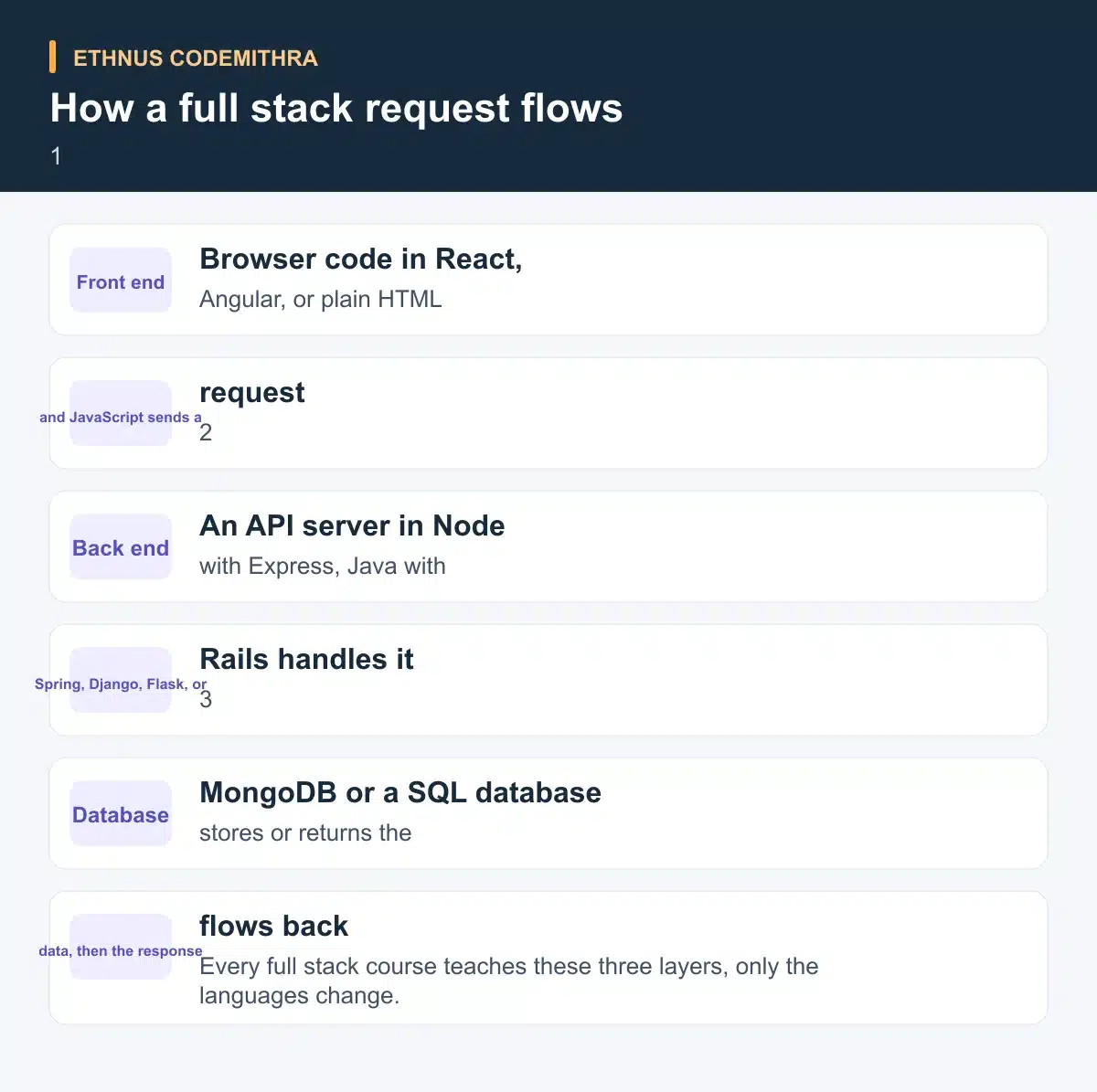
Every stack you read about below arranges these three parts with a different set of languages and frameworks. The layers stay the same. Only the tools change.
The five stacks, compared
MERN pairs Node.js and Express.js on the back end with React on the front end, and MongoDB as the database. Node.js describes itself as an event-driven JavaScript runtime for building scalable network applications. React calls itself "the library for web and native user interfaces." MEAN swaps React for Angular, a web framework maintained by Google. Python full stack usually pairs Django, "the web framework for perfectionists with deadlines," or the lighter Flask, with a front end of choice. Ruby on Rails pairs the Ruby language with Rails, which describes itself as a full-stack framework built on convention over configuration.
The table below adds one more data point: how often developers report using each technology, from the Stack Overflow Developer Survey 2025. This is usage share among developers who answered the survey. It is not a measure of local hiring demand or salary, and it should not be read as either.
| Stack | Primary language | Front-end framework | Back-end framework or runtime | Typical prerequisite | 2025 developer usage share | Taught by Ethnus |
|---|---|---|---|---|---|---|
| MERN | JavaScript | React (44.7%) | Node.js (48.7%), Express (19.9%) | Comfort with HTML, CSS, and JavaScript basics | Node.js 48.7%, React 44.7%, Express 19.9% | Yes, MERN Full Stack |
| Java full stack | Java | HTML, CSS, JavaScript (JaWEsome pairs Java with core web skills rather than a separate front-end framework) | Java and a web layer | Willingness to learn a compiled, object-oriented language first | Not tracked as a single row in the survey. Java itself is a separate, widely used language | Yes, JaWEsome |
| MEAN | JavaScript | Angular (18.2%) | Node.js (48.7%), Express (19.9%) | Comfort with JavaScript and TypeScript conventions | Angular 18.2% | No, Ethnus does not currently offer a dedicated MEAN course |
| Python full stack | Python | Front end of choice, often paired with a template system | Django (12.6%) or Flask (14.4%) | Basic Python syntax | Flask 14.4%, Django 12.6% | No, Ethnus does not currently offer a dedicated Python full-stack course |
| Ruby on Rails | Ruby | Rails view templates or a separate front end | Rails (5.9%) | Basic Ruby syntax | Ruby on Rails 5.9% | No, Ethnus does not currently offer a dedicated Rails course |
Ethnus's own course catalogue currently lists MERN Full Stack and JaWEsome (Java and Web Essentials) as its full-stack options. Separate courses cover AWS, cybersecurity, and Salesforce. Ethnus does not list a standalone MEAN, Python full-stack, or Ruby on Rails course. That fact should shape your decision if you plan to train with Ethnus specifically.
Decision guide: MERN vs Java
For most beginners in India choosing between Ethnus's two full-stack courses, the real question is simple. Do you want to write JavaScript everywhere, or start with a compiled, object-oriented language used widely in enterprise systems?
Choose MERN if you want one language, JavaScript, across the browser and the server, and you want to reach a working web application quickly. The MERN Full Stack course runs 200+ hours of full stack content plus a separate 250+ hours of basic essentials. Its syllabus covers HTML5, CSS3, Bootstrap, and JavaScript including ES6 and TypeScript on the front end. The back end covers Node.js and Express.js, plus MongoDB (CRUD operations, aggregations, indexing, replication, and sharding). React covers components, routing, forms, and testing with Jest. The course also includes essentials coverage of Java fundamentals, Python basics, generative AI, DevOps, networking, and OS and shell scripting.
Choose Java full stack if you want to learn object-oriented programming properly before touching a front-end framework. It suits students comfortable with a stricter, compiled language. The JaWEsome (Java and Web Essentials) course runs 160+ hours over four weeks. It covers Java data types, control flow, arrays and strings, and object-oriented programming (classes, encapsulation, inheritance, polymorphism, overloading and overriding). It also covers exception handling, multi-threading, collections, and lambda expressions. A web layer adds HTML, CSS, JavaScript with the DOM, and AJAX, plus DBMS fundamentals (DDL and DML). Bonus content covers Python basics, generative AI, AWS, cybersecurity, Salesforce, and the MERN stack.
If you are unsure, try this exercise today. Write ten lines of JavaScript (a function that filters a list) and ten lines of Java (a class with two methods). Use any free online compiler for both. Notice which one felt more natural to read back. That reaction is a reasonable, low-cost signal for which stack to start with.
What a good beginner course should include
Before you pay for any full stack course, check for four things rather than trusting a marketing paragraph. First, a syllabus with named topics and hour counts, not just a list of technology logos. Second, hands-on projects, not only recorded lectures. Third, a way to get doubts cleared quickly, since a beginner stuck on one error for days loses momentum. Fourth, honest placement information: named hiring companies and named student outcomes, not a guaranteed percentage.
On that last point, Codemithra's placements page is a useful example of what honest placement information looks like. Its headline is "Get Trained. Get Certified. Get Placed.", and it lists 40+ hiring companies along with named individual placement outcomes. It does not state a placement rate or promise a job, and no course anywhere should promise you one either.
Both the MERN Full Stack and JaWEsome pages list trainer-led sessions with doubt clearing, practice interviews, and a resume building workshop. The MERN Full Stack course ends in a course completion certificate that names the specific topics covered rather than a generic label.
A specific feature worth checking: CLAP
Codemithra runs its full stack courses on the Codemithra Learning and Assessment Platform (CLAP). CLAP gives students continuous assessments and additional learning material alongside the trainer-led sessions. That is a specific, named platform, not a generic promise of "quality learning". When you compare courses, ask each provider what platform, if any, sits behind the syllabus, and what a continuous assessment actually checks.
Where Ethnus fits
Ethnus reached the milestone of training over 5 lakh students across all its courses. It is also authorised as a training partner for AWS, Oracle, and EC-Council, with a focus on cloud computing, cybersecurity, IoT, AI, and ML. That is a historical, cross-course figure, not a claim specific to full stack training. For full stack specifically, Ethnus's own offer is the two courses compared above: MERN Full Stack and JaWEsome. Both course pages list their hours and syllabus in enough detail to compare against any other provider.
Frequently asked questions
Is MERN or Java full stack better for a first job?
Neither is inherently better. MERN uses one language, JavaScript, across the stack, which some beginners find faster to start with. Java full stack teaches object-oriented programming more rigorously first. Choose based on which language you would rather write every day, not on an unverified job-market claim.
Does Ethnus teach MEAN, Python full stack, or Ruby on Rails?
No. Ethnus's current course catalogue lists MERN Full Stack and JaWEsome as its full stack options, alongside AWS, cybersecurity, and Salesforce courses. If you specifically want MEAN, Python full stack, or Rails, you will need a different provider for that stack.
How long do the Ethnus full stack courses take?
The MERN Full Stack course runs 200+ hours of full stack content plus a separate 250+ hours of basic essentials. JaWEsome runs 160+ hours over four weeks. Both figures come directly from their course pages, linked above.
Will a full stack course guarantee me a job?
No course can guarantee a job, and you should be cautious of any that claims to. Codemithra's placements page lists named hiring companies and named student outcomes instead of a guaranteed rate, which is the honest way to present placement support.
What should I check before enrolling in any full stack course?
Check the syllabus for named topics and hour counts. Confirm the course includes hands-on projects rather than only lectures. Ask how doubts get cleared, and read the placement page for named companies and outcomes rather than a promised percentage.
If JavaScript across the stack appeals to you, start with the syllabus on the MERN Full Stack course page. If you would rather build a foundation in object-oriented programming first, check the JaWEsome course page instead.