
Becoming a MERN stack developer is a reasonable career move if you can commit the hours. It gives you one skill set that covers both the browser and the server. MERN stands for MongoDB, Express.js, React and Node.js. Together they let one developer build a web application end to end. That spans the clickable interface and the database behind it. This article explains what each layer does and shows how a request moves through all four. It also gives a checklist for judging any structured course: named modules for each layer, a clear hour count, and a stated certificate policy.
What MERN actually stands for
MongoDB is a document-oriented database. Instead of fixed relational tables, it stores data as flexible, JSON-like documents. These documents can hold nested fields (MongoDB, NoSQL databases explained). That model suits data that does not fit neatly into rows and columns.
Express.js describes itself as "a fast, unopinionated, minimalist web framework for Node.js" (Express.js homepage). It handles routing, middleware and the request-response cycle on the server. You do not write raw HTTP handling by hand.
React is commonly described as a JavaScript library for building user interfaces (react.dev). It breaks a page into reusable components and re-renders only the parts of the screen that change.
Node.js is "an open-source and cross-platform JavaScript runtime environment" (Node.js, Introduction to Node.js). It "runs the V8 JavaScript engine, the core of Google Chrome, outside of the browser". That is what lets Express and your server code run at all.
Put together: MongoDB stores the data. Express and Node run the server and handle requests. React renders what the user sees. Learning all four means you can build and reason about a complete application instead of only one layer of it.
How a full-stack request actually flows
The phrase "full-stack" is easier to understand as a sequence of hops than as a job title. Here is what happens between a user clicking something and seeing a result.
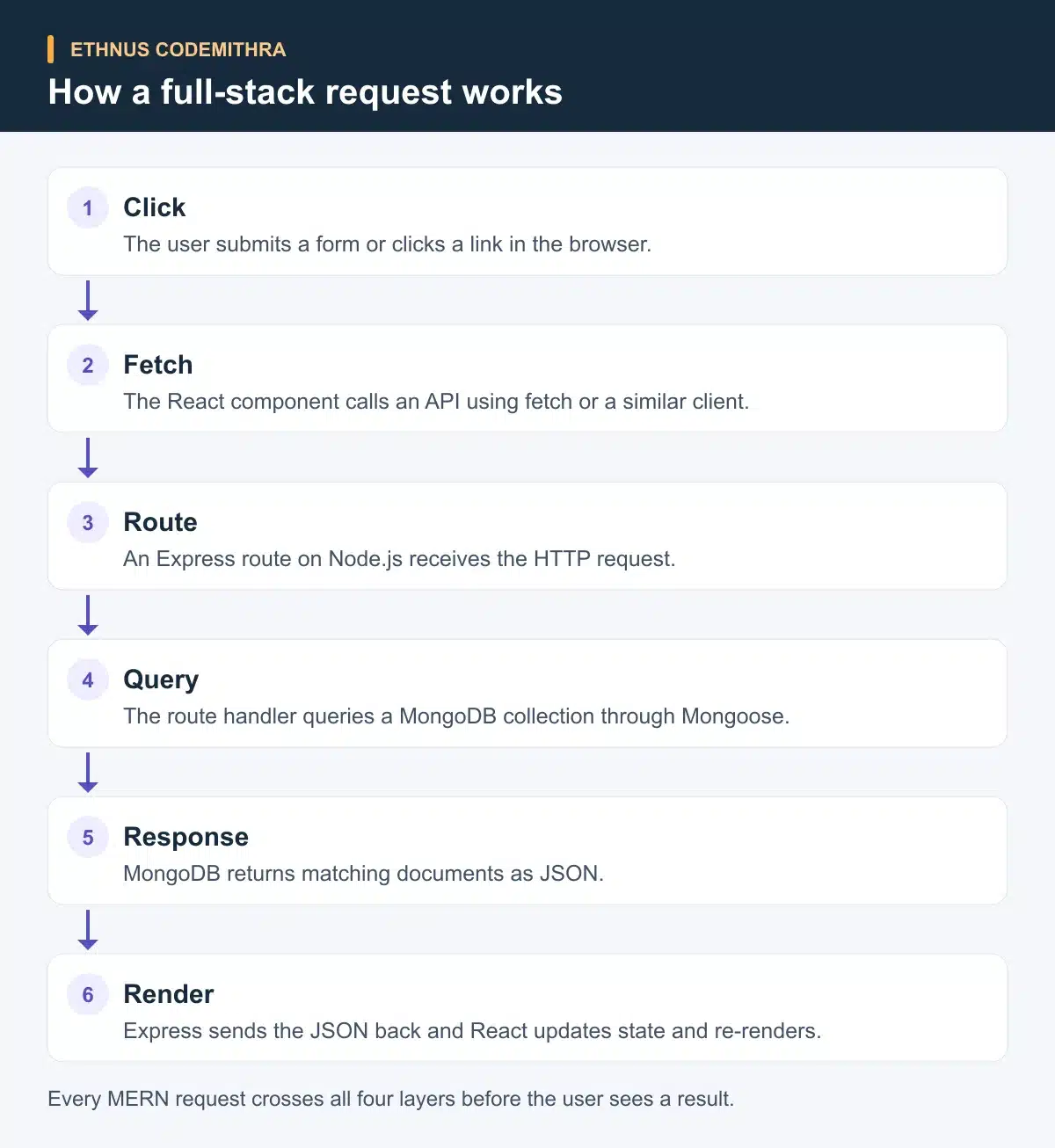
Six things happen, in order. The user clicks a button or submits a form in the browser. A React component fires a request to an API endpoint. An Express route running on Node.js receives that HTTP request. The route handler queries a MongoDB collection, usually through a tool such as Mongoose. MongoDB returns the matching documents. Express sends that data back as JSON, and React updates its state and re-renders the screen.
A front-end-only developer stops after the second step. A back-end-only developer starts at the third. A full-stack developer can trace, and debug, the whole path.
What each role owns day to day
The table below is an editorial breakdown of typical responsibilities, not a claim about any specific job listing. Use it to decide which parts of the stack you actually want to work in.
| Area | Front-end-only developer | Back-end-only developer | Full-stack (MERN) developer |
|---|---|---|---|
| UI and client state | Owns this fully: components, styling, state management | Not involved | Owns this, using React |
| API and business logic | Consumes an API someone else built | Owns this fully: routes, middleware, validation | Owns this, using Express and Node.js |
| Data modelling and queries | Not involved | Owns this fully: schema design, queries, indexing | Owns this, using MongoDB |
| Authentication and sessions | Handles tokens received from the server | Issues and verifies tokens or sessions | Handles both ends of the same flow |
| Deployment and environment | Static hosting or a build pipeline | Server, process and database hosting | Needs to reason about both |
| Typical debugging surface | Browser console, rendering, network tab | Server logs, database queries, server errors | Any point in the chain, browser to database |
A minimal working example
A short example makes the flow above concrete. This Express route uses Mongoose to read documents from a MongoDB collection called tasks.
// server: routes/tasks.js
const express = require('express');
const router = express.Router();
const Task = require('../models/Task');

router.get('/api/tasks', async (req, res) => {
  try {
    const tasks = await Task.find({});
    res.json(tasks);
  } catch (err) {
    res.status(500).json({ error: 'Could not load tasks.' });
  }
});

module.exports = router;
The matching React component fetches that endpoint and renders the list.
// client: TaskList.jsx
import { useEffect, useState } from 'react';

function TaskList() {
  const [tasks, setTasks] = useState([]);

  useEffect(() => {
    fetch('/api/tasks')
      .then((res) => res.json())
      .then((data) => setTasks(data))
      .catch(() => setTasks([]));
  }, []);

  return (
    <ul>
      {tasks.map((task) => (
        <li key={task._id}>{task.title}</li>
      ))}
    </ul>
  );
}

export default TaskList;
Notice the shape: the server exposes JSON, and the client asks for it and renders it. Every MERN feature you build is a variation on this pattern, in both directions.
What a structured MERN course should actually deliver
Use this as a checklist for evaluating any full-stack course, not only one from Ethnus Codemithra. A course worth the time should be able to answer these questions with specifics, not adjectives.
- How many hours of instruction, across which named modules?
- Does MongoDB coverage include CRUD operations, aggregation and indexing, not just an introduction to documents?
- Does Express coverage include middleware and templating, not just routing basics?
- Does React coverage include components, routing, forms and testing, not just JSX syntax?
- Does Node.js coverage include modules, the file system and debugging?
- What do you receive at the end, and is it a completion certificate or an external certification?
Ethnus Codemithra's MERN Full Stack course publishes answers to each of these. The course page states an hour count for the program, though the figure is not the same in every section of that page. Check the live page for the current total before you enrol. Checked against the official codemithra.com course page on 8 September 2026. Named syllabus modules include MongoDB (CRUD operations, aggregations, indexing) and ExpressJS (middleware, templating). They also include React (components, routing, forms, testing with Jest) and Node.js (modules, file system, debugging). The syllabus also covers HTML5, CSS3, Bootstrap and JavaScript, including ES6 and TypeScript. It adds Java Fundamentals, Tech Essentials and basics of Python and Gen AI. On completion, it awards a Certificate of Course Completion, which recognises finishing the syllabus rather than a third-party vendor certification.
Placement assistance, honestly scoped
The course page names three placement-related elements. These are a resume building workshop, practice interviews and continuous placement opportunities (Codemithra, MERN Full Stack course). It also names trainer-led sessions with instant doubt clearing as part of delivery. None of this is a guarantee of a job or a salary. This article does not treat it as one.
Codemithra's placements page carries the tagline "Get Trained. Get Certified. Get Placed." It names hiring partners including Supai Infotech, Cloud Odyssey, Forcepoint and Infosys. It also names graduates placed at NTT Data, Mphasis and Sonata Software as examples. Treat these as illustrative outcomes some graduates have reported, not a projection for every student. The page does not state a placement rate or timeline.
Where Ethnus fits, and the next step
Ethnus operates Codemithra under Ethnus Consultancy Services Private Limited, based in Jayanagar, Bengaluru (Codemithra, About us). Across all its programs, not specific to MERN, Ethnus reached the milestone of training over 5 lakh students (Ethnus, About). If the checklist above is what you want from a course, open the current MERN Full Stack syllabus and batch details. Compare it against the questions in this article before you enrol.
Frequently asked questions
What is MERN stack development?
MERN is a set of four technologies used together to build web applications: MongoDB for data storage, Express.js and Node.js for the server, and React for the interface. Learning all four lets one developer build and debug a complete application.
What does the Ethnus Codemithra MERN course actually include?
The course page states an hour count for the program, though the figure differs across sections of that page. Check the live page for the current total. The syllabus covers HTML5, CSS3, Bootstrap and JavaScript (ES6, TypeScript). It then covers MongoDB (CRUD, aggregation, indexing), Express (middleware, templating), React (components, routing, forms, Jest testing) and Node.js (modules, file system, debugging). It also covers Java Fundamentals, Tech Essentials and basics of Python and Gen AI, and ends with a Certificate of Course Completion.
Do I need prior coding experience to start?
The published syllabus starts from HTML, CSS and JavaScript fundamentals before moving into MongoDB, Express, React and Node.js. The course design assumes no prior full-stack experience.
What does placement assistance actually consist of?
The course page names a resume building workshop, practice interviews and continuous placement opportunities. The placements page names hiring partners and graduate examples too. This is assistance, not a guaranteed job or salary outcome.
Is the certificate the same as an industry certification?
No. It is a Certificate of Course Completion covering HTML, CSS, Bootstrap, JavaScript, MongoDB, ExpressJS, ReactJS and NodeJS. Codemithra awards it for finishing the syllabus, not for passing an external vendor exam.