
AWS Certified AI Practitioner (AIF-C01) is a foundational exam. It tests whether you understand AI, machine learning and generative AI concepts. It also checks whether you know which AWS service fits which use case. It does not test whether you can code a model, tune a training job or build a data pipeline. AWS sets no formal prerequisite for it. AWS does recommend baseline AWS knowledge first if you are new to the platform. Checked against the official AWS Certified AI Practitioner page on 8 September 2026.
AIF-C01 is the current, active version of this exam. It targets people who use AI and ML on AWS without necessarily building the underlying solutions. AWS describes the target candidate as someone in a cloud, development, data, IT, AI/ML or line-of-business role. That candidate wants to validate foundational AI/ML knowledge (AWS certification page). Without an ML background, study the concepts and AWS use cases in the exam guide's domain list, not code or model building. The rest of this guide covers what the exam checks and what it leaves out. It also covers how the exam is scored, plus a study plan and exercise you can start today.
What the exam actually covers
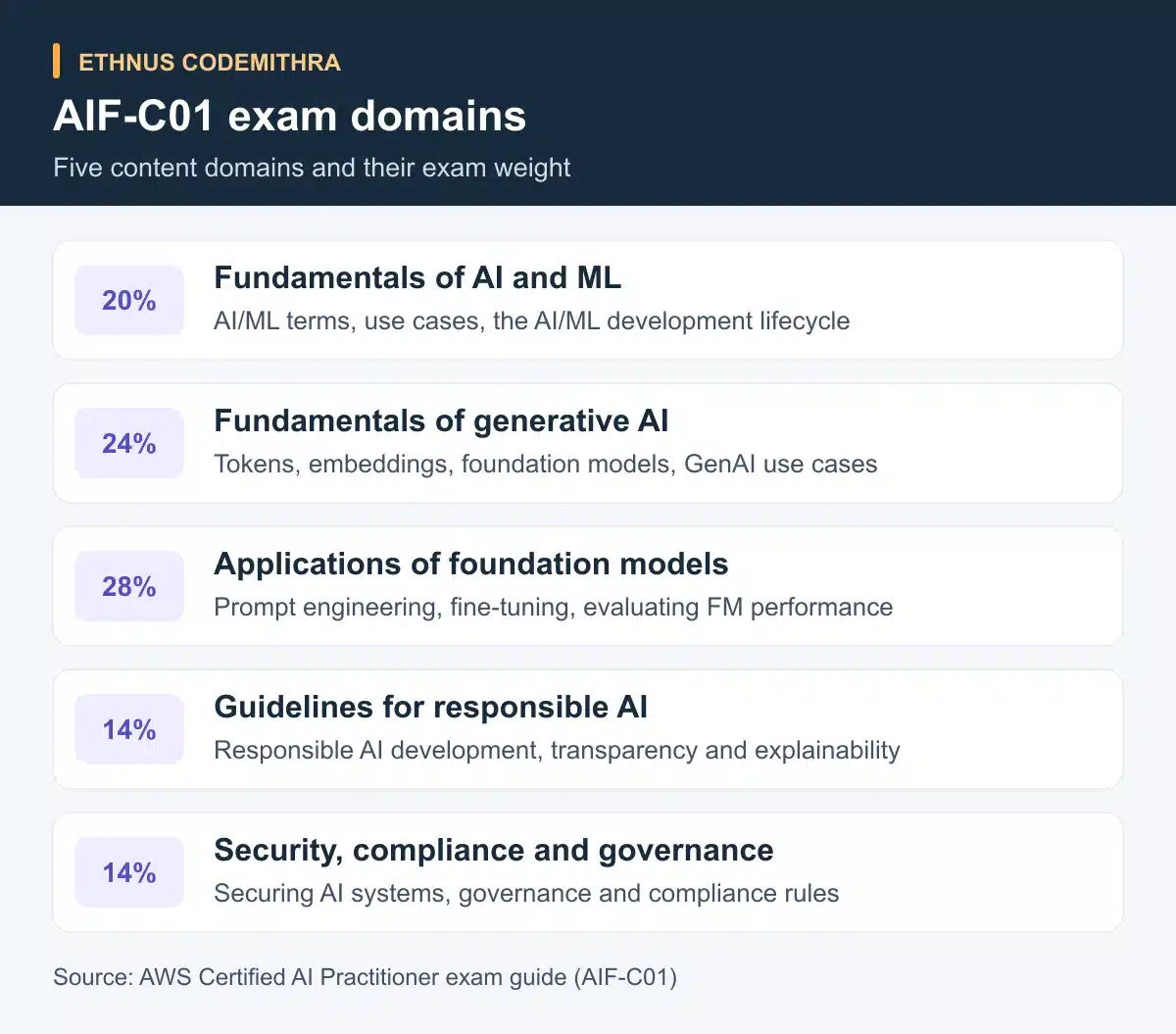
The AIF-C01 exam guide splits the content into five domains, each with a fixed weight of the total score.
- Fundamentals of AI and ML (20%): basic AI/ML terms, common use cases, and the stages of an AI/ML development lifecycle.
- Fundamentals of generative AI (24%): concepts such as tokens, embeddings and foundation models, plus typical generative AI use cases.
- Applications of foundation models (28%): prompt engineering, fine-tuning approaches and how to evaluate a foundation model's performance.
- Guidelines for responsible AI (14%): practices for responsible AI development, including transparency and explainability.
- Security, compliance and governance for AI solutions (14%): securing AI systems and understanding governance and compliance rules.
Applications of foundation models carries the largest single weight. Give extra study time to prompt engineering and evaluating model output.
What is explicitly out of scope
The exam guide also lists job tasks that AIF-C01 does not test. Coding or developing an AI/ML model sits outside the exam. So do data and feature engineering, hyperparameter tuning, building or deploying AI/ML pipelines, and statistical analysis of models (exam guide). Implementing security or governance controls yourself is also out of scope. The exam checks that you understand the concepts, not that you can build the controls.
If you have no machine learning background, this list matters. You are not expected to write training code or design a pipeline to pass AIF-C01. You are expected to recognise AWS services, use cases and responsible AI concepts. You also need to know when a task calls for AI/ML at all.
The exam guide also names the AWS knowledge you should already have. This includes Amazon EC2, Amazon S3, AWS Lambda, Amazon Bedrock and Amazon SageMaker AI, and knowing what each one does. It also expects you to know the AWS shared responsibility model, AWS IAM, and AWS pricing models (exam guide). None of that requires you to operate those services in depth. You only need to know what each one does and why you would pick it.
Exam logistics
AIF-C01 has 65 questions in 90 minutes and costs 100 USD, with the price varying by local tax and currency (AWS certification page). Of the 65 questions, 50 are scored and 15 are unscored items AWS uses to calibrate future exams. You cannot tell which is which, so answer every question as if it counts (exam guide).
Questions come in four formats: multiple choice, multiple response, ordering and matching. AWS reports your result as a scaled score from 100 to 1,000, and you need 700 to pass. Scoring is compensatory, so a strong result in one domain can offset a weaker one elsewhere. There is no separate pass mark per domain (exam guide). Like other AWS certifications, AIF-C01 stays valid for three years from the date you pass. Recertification then renews it for another three years (AWS recertification policy).
AIF-C01 or Cloud Practitioner first?
If you are new to AWS as well as to AI, decide which foundational exam to sit first. AWS recommends its Cloud Practitioner Essentials or Technical Essentials training as prior study for candidates new to IT and AWS. This is a recommendation, not a required prerequisite exam (AWS certification page). The two exams sit at the same level and share a format, but they test different subject matter.
| Detail | AWS Certified AI Practitioner (AIF-C01) | AWS Certified Cloud Practitioner (CLF-C02) |
|---|---|---|
| Subject matter | AI, ML and generative AI concepts and AWS AI services | General AWS cloud concepts, core services and billing |
| Price | 100 USD | 100 USD |
| Duration | 90 minutes | 90 minutes |
| Questions | 65 (50 scored, 15 unscored) | 65 |
| Passing score | 700 of 1,000 | 700 of 1,000 |
| Suggested prior exposure | Up to 6 months with AI/ML technologies on AWS | Up to 6 months with the AWS Cloud |
| Validity | 3 years | 3 years |
Sources: AWS Certified AI Practitioner and AWS Certified Cloud Practitioner. Both list "up to 6 months of exposure" as a suggested candidate profile, not an eligibility requirement.
If you already work with AWS day to day, you can go straight to AIF-C01. If AWS itself is new to you, cover Cloud Practitioner-level material first. That way, IAM, the shared responsibility model and pricing are not new alongside AI/ML concepts.
A study plan without an ML background
Work through the domains in this order.
- Baseline AWS literacy. If AWS itself is new to you, cover core services, IAM and pricing before starting the AI content. The exam guide assumes you already know these.
- Domain by domain. Take each of the five domains and its task statements from the exam guide as a checklist. Do not move to the next domain until you can explain each task statement in your own words.
- Hands-on with the named services. The exam guide names Amazon Bedrock and Amazon SageMaker AI as core AWS AI services to know. It also names Amazon Comprehend, Transcribe, Translate, Lex and Polly. Open each one in the AWS console and read what it does, rather than only reading a summary.
Applications of Foundation Models carries the highest single weight at 28%. Spend extra time on prompt engineering technique and on evaluating a foundation model's output, not just on reading definitions.
A practical exercise: run one prompt in Bedrock
You can do this today without writing code.
- Sign up for an AWS account on the AWS free plan. New accounts get 100 USD in credit immediately, plus up to 200 USD in total over 6 months. The account closes automatically after 6 months or once the credit runs out, whichever comes first.
- Open the Amazon Bedrock console and pick a foundation model from the model catalogue. Access to Bedrock models is enabled by default once your account has the correct AWS Marketplace IAM permissions. You should not need to request access model by model. Anthropic models are the exception. They need a one-time first-time-use form describing your use case. A personal or portfolio URL is enough for an individual student (Bedrock model access documentation).
- Open the model in the console's chat or text playground and run one prompt. The Bedrock playgrounds exist specifically so you can try a foundation model without writing an API call first.
- Map what you just did back to the exam. Choosing and prompting a foundation model touches Domain 2 (foundation model concepts) and Domain 3 (prompt engineering). Reading Bedrock's access controls touches Domain 5 (security and governance).
Amazon Bedrock itself is available on both the AWS free and paid plans. A related capability, Amazon Bedrock AgentCore, is paid-plan only (AWS free plan page). This exercise is a self-directed way to connect exam content to the real console. It is not a description of a specific Ethnus batch lab.
How this fits the Ethnus Codemithra path
If you are starting from outside AWS entirely, Codemithra's AWS Cloud Practitioner Essentials program is a useful on-ramp toward AIF-C01. The course covers 50+ hours of Cloud Practitioner Essentials content, plus a 250+ hour Basic Essentials course. Its syllabus has 11 modules. Its listing states the course now includes Basics of Python and Gen AI. A Tech Essentials track also lists AI/ML Fundamentals as a topic. The course page also describes trainer-led sessions with instant doubt clearing. It lists sandbox access with unlimited lab attempts. It also describes placement support such as a resume building workshop and practice interviews. None of this replaces sitting the AWS exam yourself: only AWS's own proctored exam awards the AIF-C01 credential (AWS certification FAQ). Ethnus reached the milestone of mentoring over 5 lakh students across all its programs. That history spans the whole organisation, not this exam alone (Ethnus about page).
FAQ
Do I need coding or machine learning experience to pass AIF-C01?
No. The exam guide places coding models, feature engineering, hyperparameter tuning and building ML pipelines outside the scope of AIF-C01 (exam guide). You need to understand concepts and use cases, not build the systems.
Is there a required prerequisite exam for AIF-C01?
No. AWS recommends Cloud Practitioner Essentials or Technical Essentials training first if you are new to IT and AWS. This is a recommendation, not a formal prerequisite exam (AWS certification page).
How much does the exam cost and how long does the certification last?
The list price is 100 USD, and it can vary with local tax and currency. Like other AWS certifications, it stays valid for 3 years before recertification is needed (AWS recertification policy).
Should I take AWS Certified Machine Learning - Specialty instead?
Not as an open forward path. That exam's last delivery date for new candidates was 31 March 2026, so it is no longer available to sit (AWS Machine Learning - Specialty page). AIF-C01 remains the current foundational AI credential from AWS.
What score do I need, and how are questions scored?
You need a scaled score of 700 out of 1,000. Scoring is compensatory across the exam as a whole, so there is no separate minimum per domain (exam guide).
Use the five domains above as a checklist, then enrol in Codemithra's AWS Cloud Practitioner Essentials program first if AWS itself is still new to you.