S3 storage classes. Ethnus Codemithra article cover.

Amazon S3 storage classes explained with a lifecycle policy exercise

Codemithra Team

Codemithra Team

Pick an S3 storage class by matching it to how often the data gets read, not by memorising a list. S3 Standard suits data you read often. The infrequent-access and Glacier classes trade a lower storage price for a retrieval fee. Some also add a minimum storage duration or a longer wait to read the object. A lifecycle policy then moves an object between classes automatically as it ages. You set the rule once, instead of reclassifying objects by hand.

This matters for the AWS Certified Solutions Architect - Associate (SAA-C03) exam. Domain 4, "Design cost-optimized architectures," is 20 percent of the exam. Its first task statement lists "managing S3 object lifecycles" and "selecting the appropriate storage tier" as explicit skills. The exam guide names Amazon S3 and Amazon S3 Glacier as the in-scope services. It does not enumerate a fixed number of storage classes. Treat any claim of "six classes" with caution, and check the class names instead. Checked against the official SAA-C03 exam guide on 8 September 2026.

The storage classes that matter for this exercise

Seven classes cover almost every access pattern a candidate needs to reason about. Each one trades availability, durability, minimum storage duration or minimum billable object size for a lower storage price. The figures below come from the AWS S3 storage class comparison table.

  • S3 Standard. The default class if you do not specify one. No minimum storage duration and no minimum object size.
  • S3 Standard-IA. Same millisecond access as Standard, but with a per-GB retrieval fee. Minimum storage duration of 30 days and a minimum billable object size of 128 KB.
  • S3 One Zone-IA. Same pricing shape as Standard-IA, stored in a single availability zone. It is not resilient to the loss of that zone.
  • S3 Intelligent-Tiering. No retrieval fees. A small per-object monitoring fee, and the service moves objects between access tiers for you.
  • S3 Glacier Instant Retrieval. Millisecond access at archive prices, with a 90-day minimum storage duration and a 128 KB minimum billable object size.
  • S3 Glacier Flexible Retrieval. Retrieval takes minutes to hours, and an object must be restored before you can read it. Minimum storage duration is 90 days.
  • S3 Glacier Deep Archive. The lowest storage price, with a 180-day minimum storage duration and a restore step measured in hours.

Two more classes exist outside this mainstream path. S3 Express One Zone is a single-zone, high-performance class used with directory buckets for latency-sensitive workloads. Reduced Redundancy Storage is explicitly marked "not recommended" by AWS and carries lower durability than every other class. A separate Outposts-only class exists for buckets on Outposts hardware and cannot be used on a Region bucket. None of the three fit the lifecycle exercise in this article, so they are mentioned here and set aside.

Comparison table

Use this table to match an access pattern to a class before you write a lifecycle rule. Values are verbatim from the AWS storage class comparison table. Do not substitute the availability figures on AWS marketing pages, which round differently.

Storage class Designed for Availability (designed for) Durability Min. storage duration Min. billable object size Retrieval
S3 Standard Frequently accessed data 99.99% 99.999999999% None None Milliseconds, no retrieval fee
S3 Standard-IA Infrequent access, rapid when needed 99.9% (3+ AZs) 99.999999999% 30 days 128 KB Milliseconds, per-GB retrieval fee
S3 One Zone-IA Infrequent access, re-creatable data 99.5% (1 AZ) 99.999999999% 30 days 128 KB Milliseconds, per-GB retrieval fee
S3 Intelligent-Tiering Unknown or changing access patterns 99.9% 99.999999999% None None Milliseconds, no retrieval fee, small monitoring fee
S3 Glacier Instant Retrieval Archive data read about once a quarter 99.9% (3+ AZs) 99.999999999% 90 days 128 KB Milliseconds, per-GB retrieval fee
S3 Glacier Flexible Retrieval Archive data, occasional retrieval 99.99% (after restore) 99.999999999% 90 days None stated Minutes to hours, after a restore
S3 Glacier Deep Archive Long-term archive, rarely read 99.99% (after restore) 99.999999999% 180 days None stated Hours, after a restore

Storing an object smaller than the minimum billable object size still works. AWS bills it as if it were that minimum size. Very small objects rarely save money by moving to an infrequent-access or Glacier class.

How Intelligent-Tiering actually moves data

S3 Intelligent-Tiering removes the need to pick a class up front. It monitors access and moves each object between tiers on its own. An object starts in the Frequent Access tier. After 30 consecutive days with no access, it moves to the Infrequent Access tier. After 90 days with no access, it moves to the Archive Instant Access tier, all without a retrieval fee. See the AWS documentation on how S3 Intelligent-Tiering works.

You can also opt in to two deeper archive tiers. Archive Access holds objects untouched for 90 or more days. Deep Archive Access holds objects untouched for 180 or more days. Standard retrieval from Archive Access takes 3 to 5 hours. Standard retrieval from Deep Archive Access completes within 12 hours. One limit to remember: objects under 128 KB are never monitored or moved. They stay in the Frequent Access tier regardless of age.

Lifecycle policy diagram and worked example

A lifecycle rule automates the class changes above, but the transitions only run one way, in a fixed waterfall. You cannot write a rule that moves an object back to a cheaper-to-read class. Some classes can only transition to one specific destination.
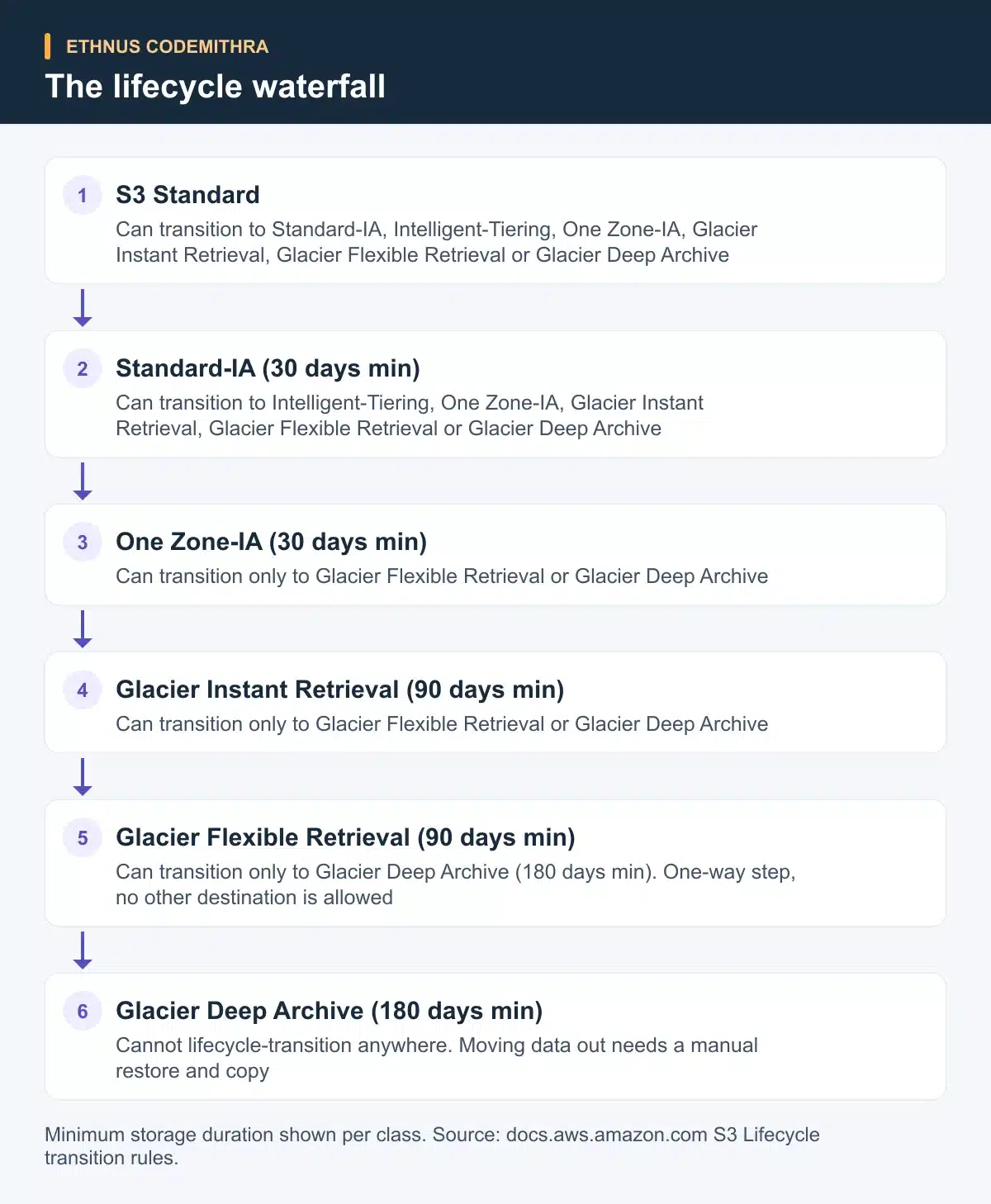
The S3 lifecycle waterfall. Standard can transition to Standard-IA, Intelligent-Tiering, One Zone-IA, Glacier Instant Retrieval, Glacier Flexible Retrieval or Glacier Deep Archive. Standard-IA, minimum 30 days, can transition to Intelligent-Tiering, One Zone-IA, Glacier Instant Retrieval, Glacier Flexible Retrieval or Glacier Deep Archive. One Zone-IA, minimum 30 days, can transition only to Glacier Flexible Retrieval or Glacier Deep Archive. Glacier Instant Retrieval, minimum 90 days, can transition only to Glacier Flexible Retrieval or Glacier Deep Archive. Glacier Flexible Retrieval, minimum 90 days, can transition only to Glacier Deep Archive, a one-way step. Glacier Deep Archive, minimum 180 days, cannot lifecycle-transition anywhere. Moving data out needs a manual restore and copy.
Supported lifecycle transitions, per the AWS documentation on transitioning objects using S3 Lifecycle.

S3 Glacier Flexible Retrieval can transition only to S3 Glacier Deep Archive. S3 Glacier Deep Archive cannot transition anywhere at all. Moving data out of either class needs a manual restore followed by a copy, not a lifecycle rule.

The minimum storage duration also constrains how soon a second transition can fire. AWS gives this example. A rule cannot move an object to Glacier Instant Retrieval at day 4, then to Deep Archive at day 20. Glacier Instant Retrieval's 90-day minimum means the Deep Archive transition must occur at day 94 or later. Read this in the transition rules documentation before you set transition days in a rule.

Try this exercise with a test bucket. Write a rule that moves objects from Standard to Standard-IA at 30 days, then to Glacier Deep Archive at 180 days. Add a size filter so objects under 128 KB stay excluded from the transition, rather than follow the platform default.

{
  "Rules": [
    {
      "ID": "standard-to-ia-to-deep-archive",
      "Status": "Enabled",
      "Filter": {
        "And": {
          "Prefix": "logs/",
          "ObjectSizeGreaterThan": 131072
        }
      },
      "Transitions": [
        {
          "Days": 30,
          "StorageClass": "STANDARD_IA"
        },
        {
          "Days": 180,
          "StorageClass": "DEEP_ARCHIVE"
        }
      ]
    }
  ]
}

Apply it with the AWS CLI once the JSON above is saved as lifecycle.json:

aws s3api put-bucket-lifecycle-configuration \
  --bucket your-test-bucket \
  --lifecycle-configuration file://lifecycle.json

This is an original exercise for practice, not a description of a specific Ethnus batch lab. Run it against a disposable test bucket and confirm the rule with aws s3api get-bucket-lifecycle-configuration.

Common exam and real-world traps

  • Early transition and deletion charges. Deleting, overwriting or transitioning an object before its minimum storage duration elapses still bills the remaining days. See the storage class documentation for each class's rate.
  • Glacier metadata overhead. Archiving an object to Glacier Flexible Retrieval or Glacier Deep Archive adds 40 KB of per-object metadata overhead. That overhead bills 32 KB at the Glacier rate and 8 KB at the S3 Standard rate. Archiving many small objects costs more than archiving fewer, larger ones.
  • Tag-based filters run on a delay. A lifecycle rule filtered by tag is evaluated daily. The queued transition then executes asynchronously, re-checking the tag at execution time. Removing a tag does not guarantee you cancel a transition that is already queued.
  • The September 2024 small-object default changed. Since September 2024, S3 Lifecycle's default behaviour blocks objects smaller than 128 KB from transitioning to any storage class. Before that change, small objects could still transition to the two Glacier classes by default. A configuration created before the change keeps the old default until you edit it. Check when a rule was created before assuming which behaviour applies. Add an ObjectSizeGreaterThan or ObjectSizeLessThan filter to control this explicitly, as in the sample rule above. See the transition rules documentation for the exact wording of this change.

Official AWS Certified Solutions Architect - Associate certification badge, published by AWS.
The AWS Certified Solutions Architect - Associate badge identifies the exam this domain belongs to. It is not evidence that any person or institute holds the credential.

How this fits Ethnus training

The Codemithra AWS Solutions Architect - Associate course lists "Introduction to Storage - EBS, S3" under its AWS Foundational Services syllabus section. That is where a storage class decision like this one first comes up. The course includes lab and sandbox access with step-by-step walkthroughs. You can build a test bucket there and run the lifecycle exercise above instead of only reading about it. Trainer-led sessions and quizzes run alongside the labs. The program adds a resume workshop and practice interviews as part of its career-support track. Try the exercise on your own account first, then bring the questions it raises into a live session.

Practical takeaway

Use this checklist before you write a lifecycle rule.

  • Data read daily or unpredictably: keep it in S3 Standard, or move to Intelligent-Tiering if the pattern is unclear.
  • Data read a few times a month, needs millisecond access: S3 Standard-IA, or One Zone-IA if an availability zone failure is an acceptable risk.
  • Archive data read about once a quarter, needs millisecond access: S3 Glacier Instant Retrieval.
  • Archive data read a few times a year, minutes-to-hours retrieval is acceptable: S3 Glacier Flexible Retrieval.
  • Archive data kept mainly for compliance, read rarely if ever: S3 Glacier Deep Archive.
  • Check the source class's minimum storage duration before setting a transition day, so the next step is not too early.

Build this into a working habit inside a full AWS architecture course. Start with the AWS Solutions Architect - Associate program at Codemithra. There, S3 sits alongside EC2, IAM and the other services this domain covers.

Frequently asked questions

How many S3 storage classes does the SAA-C03 exam guide list?

The exam guide does not list a specific number. It names Amazon S3 and Amazon S3 Glacier as in-scope services under Domain 4. Listed skills there include "managing S3 object lifecycles" and "selecting the appropriate storage tier."

Can a lifecycle rule move an object out of Glacier Deep Archive?

No. Glacier Deep Archive cannot lifecycle-transition to any other class. Moving an object out requires a manual restore followed by a copy to a different class or bucket.

Why did my small object not move to Glacier as expected?

Since September 2024, S3 Lifecycle's default behaviour excludes objects smaller than 128 KB from any transition. Add an ObjectSizeGreaterThan filter if you want smaller objects included, or check whether the rule predates the change.

Does S3 Intelligent-Tiering remove the need to choose a class?

It removes the need to guess an access pattern up front. It monitors each object and moves it between tiers automatically. Objects under 128 KB are excluded from monitoring and stay in the Frequent Access tier.

Is S3 Standard-IA less durable than S3 Standard?

No. Both are designed for 99.999999999% durability. The difference is availability and cost: Standard-IA carries a lower designed availability and a per-GB retrieval fee in exchange for a lower storage price.
About the Author

Read More

Ethnus User Agreement

I agree to submit my personally identifiable information to Ethnus, who may use it to communicate regarding their events, courses, and other services through various media including phone calls, text messages, email, and social media. I also agree with Ethnus' Privacy Policy and Terms of Service.

I agree with Ethnus sharing my personal data, including email address, with Salesforce family of companies, who may contact me for sales and marketing purposes and as described in Salesforce's Privacy Statement.

Privacy Policy

This Privacy Notice describes how we collect and use your personal information in relation to Ethnus websites, applications, products, services, events, and experiences that reference this Privacy Notice (together, "Ethnus Offerings").

This Privacy Notice does not apply to the "content" processed, stored, or hosted by our customers using Ethnus Offerings in connection with an Ethnus account. This Privacy Notice also does not apply to any products, services, websites, or content that are offered by third parties or have their own privacy notice.

Personal Information We Collect

We collect your personal information in the course of providing Ethnus Offerings to you.

Here are the types of information we gather:

        a) Information You Give Us: We collect any information you provide in relation to Ethnus Offerings. Click here to see examples of information you give us. Example: Name, email, phone, etc.

        b) Automatic Information: We automatically collect certain types of information when you interact with Ethnus Offerings. Example: IP address, location, browser identity, etc.

        c) Information from Other Sources: We might collect information about you from other sources, including service providers, partners, and publicly available sources. Example: marketing analytics, keywords, etc.

How We Use Personal Information

We use your personal information to operate, provide, and improve Ethnus Offerings. Our purposes for using personal information include:

        a) Provide Ethnus Offerings: We may use your personal information to provide and deliver Ethnus Offerings and process transactions related to Ethnus Offerings, including registrations, subscriptions, purchases, and payments.

        b) Measure, Support, and Improve Ethnus Offerings: We use your personal information to measure use of, analyze the performance of, fix errors in, provide support for, improve, and develop Ethnus Offerings.

        c) Recommendations and Personalization: We use your personal information to recommend Ethnus Offerings that might be of interest to you, identify your preferences, and personalize your experience with Ethnus Offerings.

        d) Comply with Legal Obligations: In certain cases, we have a legal obligation to collect, use, or retain your personal information.

        e) Communicate with You: We use your personal information to communicate with you in relation to Ethnus Offerings via different channels (e.g., by phone, email, chat) and to respond to your requests.

        f) Marketing: We use your personal information to market and promote Ethnus Offerings. We might display interest-based ads for Ethnus Offerings.

        g) Purposes for Which We Seek Your Consent: We may also ask for your consent to use your personal information for a specific purpose that we communicate to you.

Cookies

To enable our systems to recognize your browser or device and to provide Ethnus Offerings, we use cookies.

How We Share Personal Information

Information about our customers is an important part of our business and we are not in the business of selling our customers' personal information to others. We share personal information only as described below and with Ethnus Consultancy Services Private Limited, . and its affiliates that are either subject to this Privacy Notice or follow practices at least as protective as those described in this Privacy Notice.

Transactions Involving Third Parties: We make available to you services, software, training, and content provided by third parties for use on or through Ethnus Offerings. You can tell when a third party is involved in your transactions, and we share information related to those transactions with that third party. For example, you can order services, software, and content from sellers using the Authorized Training Partner's marketplace and we provide those sellers information to facilitate your subscription, purchases, or support.

Other than as set out above, you will receive notice when personal information about you might be shared with third parties, and you will have an opportunity to choose not to share the information.

How We Secure Information

        a) We protect the security of your information during transmission to or from websites, applications, products, or services by using encryption protocols and software.

        b) We maintain physical, electronic, and procedural safeguards in connection with the collection, storage, and disclosure of personal information.

Internet Advertising and Third Parties

Ethnus Offerings may include third-party advertising and links to other websites and applications. Third party advertising partners may collect information about you when you interact with their content, advertising, or services. For more information about third-party advertising, including interest-based ads, please read our Interest-Based Ads notice.

Access and Choice

You have choices about the collection and use of your personal information. Many Ethnus Offerings include settings that provide you with options as to how your information is being used. You can choose not to provide certain information, but then you might not be able to take advantage of certain Ethnus Offerings.

        a) Communications: If you do not want to receive promotional messages from us, please unsubscribe or adjust your communication preferences in the emails.

        b) Advertising: If you don't want to see interest-based ads, please adjust your Advertising Preferences.

        c) Browser and Devices: The Help feature on most browsers and devices will tell you how to prevent your browser or device from accepting new cookies, how to have the browser notify you when you receive a new cookie, or how to disable cookies altogether.

Children's Personal Information

We don't provide Ethnus Offerings for purchase by children. If you're under 18, you may use Ethnus Offerings only with the involvement of a parent or guardian.

Retention of Personal Information

We keep your personal information to enable your continued use of Ethnus Offerings, for as long as it is required in order to fulfill the relevant purposes described in this Privacy Notice, as may be required by law (including for tax and accounting purposes), or as otherwise communicated to you. How long we retain specific personal information varies depending on the purpose for its use, and we may delete your personal information in accordance with applicable law.

Contacts, Notices, and Revisions

If you have any concern about privacy at Ethnus, you may also contact us at the addresses below:

Ethnus Consultancy Services Pvt Ltd,

SST Chambers, No.151/17/1 Second Floor, 36th Cross Rd, 5th Block, Jayanagar, Bengaluru, Karnataka 560041

Or, email us at [email protected]

Or call us at: +91 - 8929 334 324

You will find the updated contact information on our website: www.ethnus.com/contact/

If you interact with Ethnus Offerings on behalf of or through your organization, then your personal information may also be subject to your organization's privacy practices, and you should direct privacy inquiries to your organization.

Our business changes constantly, and our Privacy Notice may also change. You should check our website frequently to see recent changes. You can see the date on which the latest version of this Privacy Notice was posted. Unless stated otherwise, our current Privacy Notice applies to all personal information we have about you and your account. We stand behind the promises we make, however, and will never materially change our policies and practices to make them less protective of personal information collected in the past without informing affected customers and giving them a choice.

Terms & Conditions

This Privacy and Security Policy is provided for the benefit of customers and clients of Ethnus Consultancy Services Private Limited. ("Ethnus") as well as other consumers and parties who use Ethnus and/or its website(s), particularly codemithra.com ("Website", "www.codemithra.com", "Codemithra" or "Ethnus Codemithra"), and/or applications ("Apps") (collectively, "Ethnus Services" or "Ethnus Platform").

Since Ethnus serves several different audiences, customers find it helpful to read the Terms of Use that apply specifically to them based upon the purpose for which they use Ethnus. For this reason, we link to three separate agreements below for employer customers, job seeker customers, and staffing customers, respectively.

For your convenience, we define each of these audiences that Ethnus serves as follows:

"Employer Customer" means an entity using Ethnus Services that is seeking to hire an individual as an employee and/or independent contractor to be employed by it directly.

"Job Seeker Customer" means an individual using Ethnus Services who is seeking to be employed as an employee or independent contractor by an employer.

"Staffing Customer" means a staffing company using Ethnus Services that provides staffing services to their own Staffing Clients.

So long as your use of the Ethnus website and services remains within the scope of the particular audience or customer for which you began using Ethnus (e.g. a job seeker does not use Ethnus as an employer, or an employer does not use Ethnus as a job seeker), the complete Terms of Use applicable to your use of the Ethnus website and services is contained within the applicable Terms of Use linked below.

Employer Terms of Use

The following Terms of Use apply to any Ethnus Employer Customer seeking to hire employees or independent contractors for its own business. If you seek to find employees or independent contractors for the benefit of your clients (and not yourself), you need to review the Terms of Use specifically for our Ethnus Staffing Customers accessible at www.Codemithra.com/terms/staffing.

Ethnus, Inc. ("Ethnus") provides online services through which employers and staffing companies seeking employees and independent contractors can efficiently and effectively review and interview candidates. Ethnus provides these services and its suite of features and products through its Apps and Website (collectively, "Ethnus Services") subject to these terms of use ("Terms of Use") and the agreements incorporated herein.

Your privacy is very important to us. We designed our accompanying Privacy and Security Policy to provide important disclosures about how your information will be used by Ethnus in providing you Ethnus Services. These Terms of Use expressly incorporate our Privacy and Security Policy.

Please read these Terms of Use and our Privacy and Security Policy carefully before using any of the diverse Ethnus Services. By visiting the Website, installing any of the Apps, and/or using any of the Ethnus Services, you shall have affirmed your agreement to these Terms of Use.

1. Definitions

2. Modifications - Will Ethnus ever modify these Terms of Use?

3. Ethnus Services - What are the Ethnus Services?

4. Video Content and Services - How and when do you record videos?

5. Pricing, Payments, and Billing - How and when will I be billed for Ethnus Services?

6. Objectionable Content - What if I find content to be objectionable?

7. Customer Conduct

8. Intellectual Property

9. DMCA Policy

10. Reserved for Future Use

11. Resale of Services

12. Indemnification

13. Disclaimer of Warranties

14. Third Party Links and Products

15. Limitations of Liability

16. Exclusions and Limitations

17. General Terms

1. Definitions

"Consumer" means any individual or entity that uses any of the Ethnus Services. Where applicable, the term "Consumer" shall encompass all Ethnus Customers.

"Content" means all material, whether publicly posted or privately transmitted, available on or through any of the Ethnus Services.

"Customer" means, for purposes of this Terms of Use, You, a Job Seeker Customer.

"Customer Content" means any Content uploaded to and/or created through the Ethnus Services by a Ethnus Customer.

"Employer Customer" means an entity using Ethnus Services that is seeking to hire an individual as an employee and/or independent contractor to be employed by it directly.

"GDPR" means the European Union's General Data Protection Regulation.

"Job Seeker Customer" means an individual using Ethnus Services who is seeking to be employed as an employee or independent contractor by an employer.

"Profile Video" means a promotional video created by a Job Seeker Customer to promote themselves as a candidate employee and/or independent contractor. It is not an interview. The Job Seeker Customer completes this independently and on their own.

"Software" means any necessary software used in connection with the Ethnus Services.

"Ethnus Account" means an account associated with a Ethnus Customer who uses or has used Ethnus Services.

"Ethnus Content" means any Content excluding Customer Content and Video Content in which Ethnus does not participate.

"Ethnus Customer" means any person who uses or has used Ethnus Services including, but not limited to, Employer Customers, Job Seeker Customers, and Staffing Customers.

"Ethnus Services" means the suite of features, products and services offered through Ethnus, its Apps, its App Services, the Website, and the Website Services.

"Ethnus Trademarks" means any trademarks, tradenames, logos, and other commercial designs of Ethnus or licensed to Ethnus, whether or not formal registration exists including, but not limited to, "Ethnus."

"Staffing Clients" means third-party employer clients of Staffing Customers.

"Staffing Customer" means a staffing company using Ethnus Services that provides staffing services to their own Staffing Clients.

"Strategic Partners" means those trusted partners that Ethnus employs, engages, or retains to perform functions and/or provide services on its behalf.

"Sub Accounts" means subsidiary accounts created for or by an Employer Customer or Staffing Customer ("such as a consultant group or employer") under its primary account.

"Username" means the valid email address provided by each Ethnus Customer to be used as their username or login identification.

"Video Content" means any video content created by or associated with any Ethnus Customer accessible on and through Ethnus Services including, but not limited to, Profile Videos, Video Questions, Video Interviews, and Welcome Videos.

"Video Interview" means an interview completed through Ethnus Services using a video or "web" camera that an Employer Customer or Staffing Customer requests a Job Seeker Customer complete. A Video Interview may involve a Job Seeker Customer alone or with other participants from an Employer Customer or Staffing Customer. A Video Interview may be pre-recorded by a Job Seeker in response to questions or occur live at which time it would be recorded.

"Video Question" means a question recorded in video and audio that can be sent to potential employee and independent contractor candidates by an Employer Customer or Staffing Customer.

"Website" means all of the content, information and services (in any format whatsoever) accessible through the World Wide Web at the domain name Codemithra.com.

"Website Services" means the services provided by Ethnus through the website at the domain name Codemithra.com, hire.li, and any of our other websites that may be used from time to time