
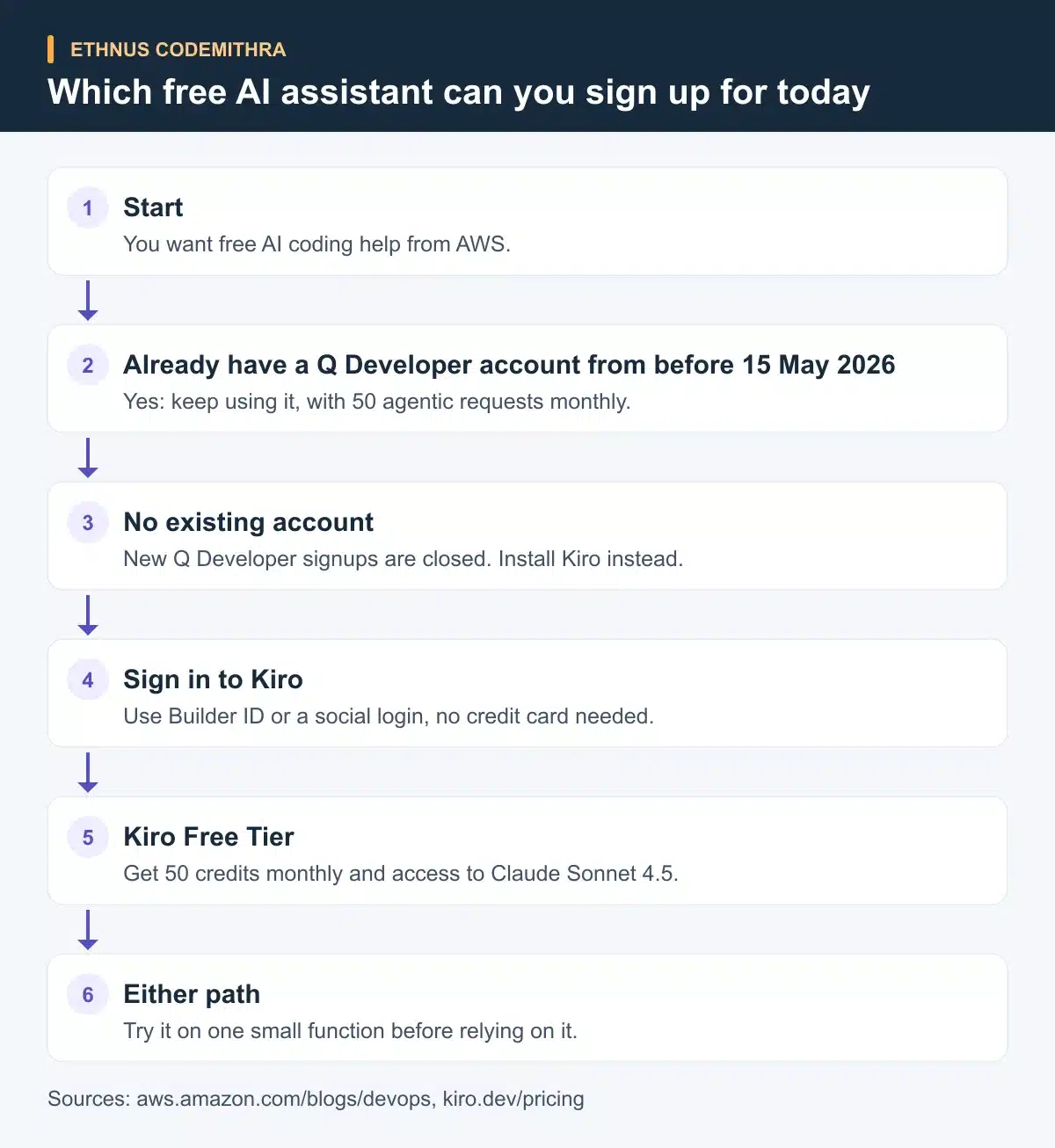
Yes, real AI coding help is available for free from AWS, but the path depends on when you ask. Amazon Q Developer's Free Tier is genuine. It gives 50 agentic chat requests and 1,000 lines of code transformation per month. Sign-in uses a free AWS Builder ID, and no AWS account is required (Amazon Q Developer pricing, Amazon Q Developer documentation). The catch: AWS closed new signups for Amazon Q Developer on 15 May 2026. It is also retiring the product on 30 April 2027, and it now points new users to a successor called Kiro (AWS end-of-support announcement). Checked against the official AWS end-of-support announcement on 8 September 2026.
If you already hold a Q Developer account created before that cutoff, keep using it. The limits below stay in place until support ends. If you are starting from scratch today, this article shows the free tier open to new users right now, plus one small exercise to try.
What Amazon Q Developer offers, for existing accounts
Amazon Q Developer works inside an IDE or the command line. It can chat about code, complete lines as you type, and generate new code from a comment. It also scans for security vulnerabilities and runs agentic tasks such as writing unit tests, drafting documentation, or reviewing a pull request (Amazon Q Developer documentation). It supports VS Code, JetBrains, Visual Studio, and Eclipse in preview, plus a CLI. Existing users can still install and update the VS Code extension today.
Two tiers apply for anyone with an existing account.
| Tier | Agentic requests | Code transformation | Cost |
|---|---|---|---|
| Free | 50 per month | 1,000 lines per month | ₹0 |
| Pro | Increased limits (no exact number published) | 4,000 lines per month pooled per account, extra lines at $0.003 each | $19 per user per month |
These figures come directly from the Amazon Q Developer pricing page. AWS does not publish an exact agentic-request number for Pro, so treat "increased limits" as the accurate description rather than guessing a figure.
Sign-in uses an AWS Builder ID, which is a separate identity from an AWS account. A Builder ID cannot get IAM credentials for the AWS Console or CLI under general availability. A limited preview lets some Builder ID accounts get them instead. It also does not require an AWS account to create (AWS Builder ID documentation). That is what made Q Developer approachable for a student trying AI coding help before ever touching AWS billing.
The 2026 status change, stated plainly
AWS announced the wind-down of Amazon Q Developer's IDE plugins and paid subscriptions on 30 April 2026. The timeline has moved in stages since then (AWS end-of-support announcement).
| Date | What happened |
|---|---|
| 30 April 2026 | AWS publishes the end-of-support announcement for Amazon Q Developer IDE plugins. |
| 15 May 2026 | New Free Tier signups through Builder ID and new paid subscriptions are blocked. Existing subscriptions can still add seats. |
| 29 May 2026 | AWS removes Claude Opus 4.6 as a model option from Amazon Q Developer Pro. |
| 30 April 2027 | Full end of support for Amazon Q Developer IDE plugins and paid subscriptions. |
AWS's own documentation carries a live end-of-support banner. It directs current and prospective users to Kiro, describing it as covering "everything you rely on today" in Amazon Q Developer, including inline suggestions, chat, and code generation (Amazon Q Developer IDE end-of-support page). The marketing and pricing pages for Amazon Q Developer have not been updated to show the signup block. Do not rely on them alone to answer "can I sign up today."
The practical path today: Kiro's free tier
Kiro is the tool AWS now points new users towards, and its free tier is open for signups right now. The Free Tier gives 50 credits per month and access to Claude Sonnet 4.5 plus open-weight models such as Qwen3 Coder Next, DeepSeek 3.2, and MiniMax M2.1. It does not require a credit card unless you later upgrade to a paid plan (Kiro pricing). Kiro's pricing page states the 50-credits figure but does not define how many chat turns or code changes that buys. Treat it as a usage allowance rather than a fixed request count.
To try it on a small task today:
- Install Kiro and sign in with an AWS Builder ID or a social login. No AWS account or credit card is required for the free tier.
- Open a small practice project, such as one MERN Express route handler or one Java class from a course exercise.
- Select a single function and ask Kiro to explain what it does and where it might fail on unexpected input.
- Ask for a lightly refactored version, then read the diff line by line before accepting anything.
Here is the kind of before-and-after to expect on one small function. The example uses a MERN Express route handler.
// Before: no validation, unclear error on bad input
app.post("/users", async (req, res) => {
  const user = await User.create(req.body);
  res.json(user);
});
// After: assistant-suggested check for a required field
app.post("/users", async (req, res) => {
  const { email } = req.body;
  if (!email || typeof email !== "string") {
    return res.status(400).json({ error: "email is required" });
  }
  const user = await User.create(req.body);
  res.json(user);
});
The value here is not the two lines added. It is reading the explanation of why the original handler could crash on a missing field. Then decide for yourself whether the suggested check is enough for your project.
Amazon Q Developer vs Kiro, side by side
| Amazon Q Developer | Kiro | |
|---|---|---|
| New signups | Closed since 15 May 2026 | Open now |
| Free tier limits | 50 agentic requests, 1,000 transformation lines per month | 50 credits per month |
| Model access | Claude Opus 4.6 removed from Pro on 29 May 2026 | Claude Sonnet 4.5 plus open-weight models |
| Supported IDEs | VS Code, JetBrains, Visual Studio, Eclipse (preview), CLI | Its own IDE and CLI |
| Card required for free tier | No, Builder ID only | No, Builder ID or social login |
| End of support | 30 April 2027 | Actively developed, no end-of-support date |
Sources for every row above: AWS end-of-support announcement, Amazon Q Developer pricing, and Kiro pricing.
Where this fits your training
Ethnus's MERN Full Stack syllabus already includes a "Basics of Python and Gen AI" module alongside its core web stack (MERN Full Stack course). The JaWEsome program pairs the same Gen AI basics with "Exposure to Emerging Technology (AWS, Cyber Security, Salesforce, and Full-stack using MERN)" (JaWEsome course). Trying a free assistant like Kiro on one function from your own practice work extends that Gen AI exposure. It is not a claim that any current batch runs an Amazon Q or Kiro lab. For structured AWS fundamentals instead of a single tool tutorial, see the AWS Cloud Practitioner Essentials course. It covers 50-plus hours of AWS content plus its own Basics of Python and Gen AI material. It also offers sandbox access with unlimited lab attempts.
Frequently asked questions
Can I still sign up for Amazon Q Developer's Free Tier today?
No. AWS blocked new Free Tier signups through Builder ID, and new paid subscriptions, starting 15 May 2026 (AWS end-of-support announcement). If you already had an account before that date, it keeps working under its existing limits until 30 April 2027.
What happens to Amazon Q Developer after 30 April 2027?
AWS discontinues support for the IDE plugins and paid subscriptions on that date. It directs users to Kiro for equivalent capabilities such as inline suggestions, chat, and code generation (Amazon Q Developer IDE end-of-support page).
Do I need an AWS account to use these tools?
No. Both Amazon Q Developer's Builder ID sign-in and Kiro's Builder ID or social login work without a full AWS account. A Builder ID cannot get IAM credentials for the AWS Console or CLI either (AWS Builder ID documentation).
Is Kiro's free tier really free, with no credit card?
Yes, for the Free Tier itself. Kiro only asks for a credit card if you choose to upgrade to a paid subscription (Kiro pricing).
Does any Codemithra course teach Amazon Q Developer or Kiro directly?
No current course page names Amazon Q or Kiro as a syllabus topic. The verified Gen AI content across these courses is the general "Basics of Python and Gen AI" module (MERN Full Stack course, JaWEsome course).
Start with structured AWS fundamentals in the AWS Cloud Practitioner Essentials course. Then bring a free assistant like Kiro into your own practice project, once you understand the code it changes.