
A credible full stack certification helps most when it forces structured practice across the whole stack. It also gives a trainer feedback loop that self-study lacks. It does not by itself guarantee a job or a salary. What matters is the program itself. Check whether it covers real front end and back end work in sequence. It should also check your progress along the way and end with something you can explain in an interview. This article shows what that looks like in a real MERN syllabus, and how to compare a certification program against learning alone.
What "full stack" means, concretely
Full stack development means writing code for two parts of a web application. One part is what a user sees. The other part stores and processes data. In the MERN stack, those parts are MongoDB, Express.js, React and Node.js, each described in its own current documentation. MongoDB calls itself "a document database with the scalability and flexibility that you want with the querying and indexing that you need" (MongoDB). Express.js is a "Fast, unopinionated, minimalist web framework for Node.js" (Express.js). Node.js is "an asynchronous event-driven JavaScript runtime, designed to build scalable network applications" (Node.js). React is a JavaScript library for building the interface. Its current documentation recommends function components with the Hooks pattern, not the older class-component style (React).
Instead of stating this as a definition, look at what happens when a user clicks something.
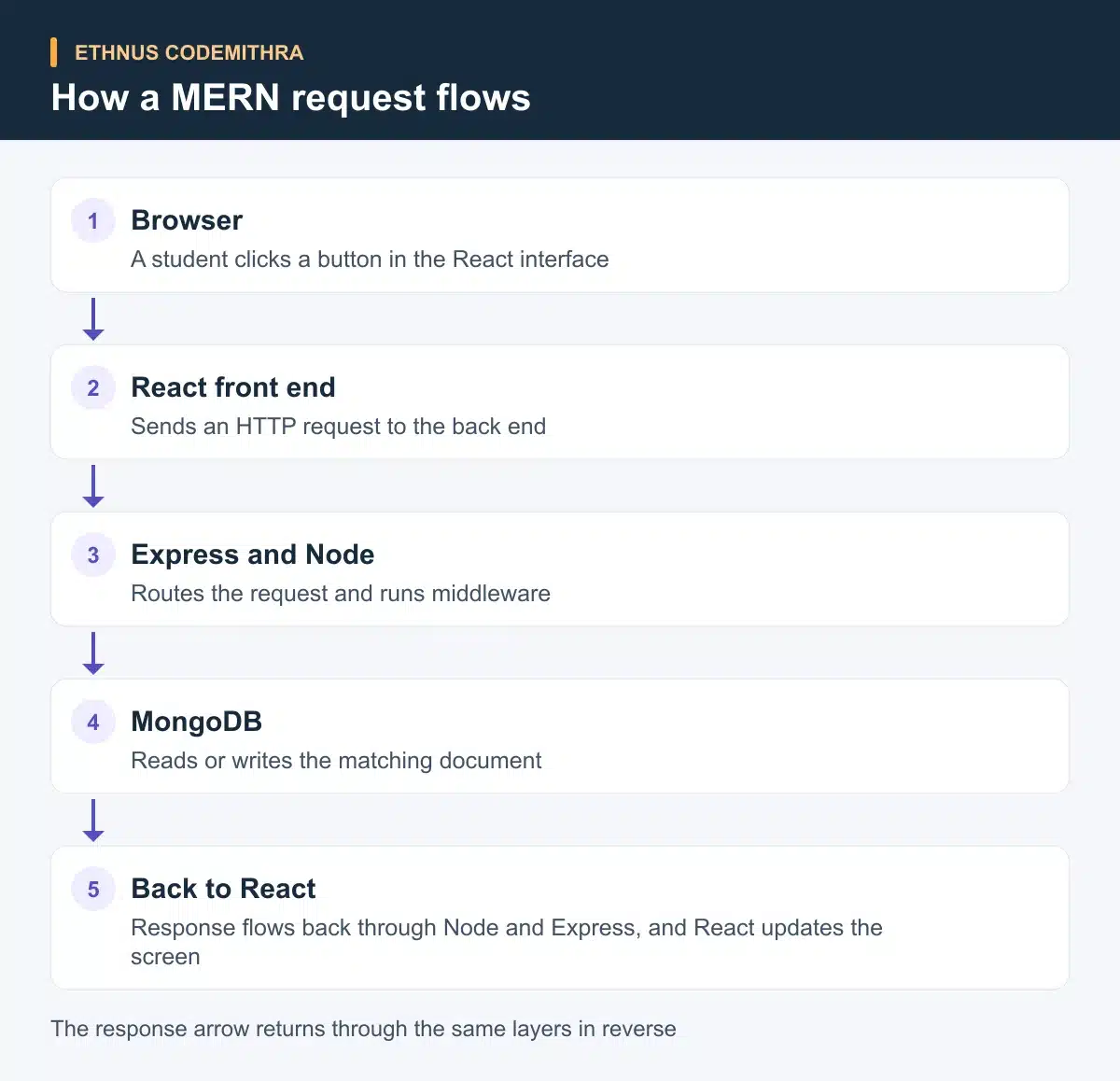
A student clicks a button in the React interface. React sends an HTTP request to the back end. Express and Node route that request. They also run any middleware needed before the request reaches the right handler. The handler reads or writes a matching document in MongoDB. The response then flows back through Node and Express to React, which updates what the student sees. A course that only lists these four names, without showing this sequence, has not taught full stack development yet.
Is the demand real?
Two separate figures are useful here. Neither is a promise about any one reader's outcome. The 2025 Stack Overflow Developer Survey asked professional developers what they use. It found 49.1% use Node.js, 46.9% use React, 24.3% use MongoDB and 20.3% use Express (2025 Stack Overflow Developer Survey). This shows how widely the stack is used in practice. It does not show how easy the stack makes it to get hired.
Separately, the US Bureau of Labor Statistics tracks employment in this field. It projects the combined web developers and digital designers occupation to grow 5% from 2025 to 2035. That is faster than the 3% average for all occupations. For the narrower web developers occupation alone, it projects 4% growth over the same period. That occupation also reports a median annual wage of $92,650 as of May 2025. This is US government data. It does not describe the Indian job market or any specific employer (US Bureau of Labor Statistics). Checked against the official Bureau of Labor Statistics page on 8 September 2026.
Self-learning vs a structured certification program
Both paths can produce a competent developer. The difference usually shows up when you get stuck, or when nobody checks your work.
| Aspect | Self-learning | Structured certification program (Ethnus Codemithra MERN) |
|---|---|---|
| Curriculum coverage | Scattered tutorials and videos, order set by you | A sequenced 200+ hour syllabus (Ethnus Codemithra MERN Full Stack course) |
| Trainer support | Forums and community answers, response time varies | Expert-led mentoring sessions with instant doubt clearing |
| Assignment feedback | Self-graded, easy to skip weak spots | Module-based assignments and assessments through the Codemithra Learning and Assessment Platform (CLAP) |
| Typical time investment | Self-paced, open-ended, no fixed end point | A defined 200+ hour program with a set structure |
Neither path is objectively better for every reader. A student who already codes and wants specific gaps filled can often self-learn faster than a fixed-pace program allows. A student starting with limited hands-on experience usually gets more value from a program that checks progress at each step.
Walking through a real MERN syllabus
Do not take a course's word for its own comprehensiveness. Compare its module list against a known sequence instead. The Ethnus Codemithra MERN Full Stack course runs 200+ hours. It starts with HTML5, CSS3 and Bootstrap. Next comes JavaScript, including ES6 and TypeScript. Then MongoDB, covering CRUD operations, aggregations, indexing and replication or sharding. Then Express.js middleware and templating. Then Node.js, covering the event loop, npm and the file system. It finishes with React, through routing, forms, deployment and JEST testing. Supplementary Java Fundamentals and Tech Essentials modules sit alongside this core sequence (Ethnus Codemithra MERN Full Stack course).
Use this list as a checklist for any program you consider. A course that skips the database layer, skips testing, or teaches React apart from the back end it talks to, is not covering full stack development end to end.
See it work: a small full stack code example
The following is a practice exercise you can try on your own machine. It is not a claim about a specific Ethnus batch project. It shows the current, documented pattern for each side of the stack, not invented syntax.
Here is a back end route that reads one document from MongoDB. It uses the official Node.js driver's current async and await pattern (MongoDB Node.js driver quick start):
const express = require("express");
const { MongoClient } = require("mongodb");

const app = express();
const uri = process.env.MONGODB_URI;

app.get("/api/students/:id", async (req, res) => {
  const client = new MongoClient(uri);
  try {
    await client.connect();
    const db = client.db("academy");
    const student = await db
      .collection("students")
      .findOne({ studentId: req.params.id });
    if (!student) {
      return res.status(404).json({ error: "Student not found" });
    }
    res.json(student);
  } finally {
    await client.close();
  }
});
Here is a front end component that displays and updates a value. It uses React's current function-component and Hooks pattern (React Quick Start):
import { useState } from "react";

function StudentLookup() {
  const [studentId, setStudentId] = useState("");
  const [student, setStudent] = useState(null);

  async function handleSearch() {
    const response = await fetch(`/api/students/${studentId}`);
    if (response.ok) {
      setStudent(await response.json());
    } else {
      setStudent(null);
    }
  }

  return (
    <div>
      <input
        value={studentId}
        onChange={(e) => setStudentId(e.target.value)}
        placeholder="Enter student ID"
      />
      <button onClick={handleSearch}>Search</button>
      {student && <p>{student.name}</p>}
    </div>
  );
}
Try changing the query to search by a different field. Or add a loading state while the request is in flight. Small changes like this are closer to real full stack work than reading about the stack.
What the certificate actually is, and is not
On successful completion, the Ethnus Codemithra MERN Full Stack course issues a Course Completion Certificate (Ethnus Codemithra MERN Full Stack course). The certificate validates the named technologies covered in the syllabus. It is a course-completion certificate from the training institution, not a third-party professional accreditation. No external accrediting body issues or backs it. Set your expectations for any full stack certification, from any provider, on this basis before you enrol.
What "placement support" concretely means here
The MERN course page names specific placement activities. These are a Resume Building Workshop, practice interviews, and what it describes as continuous placement opportunities (Ethnus Codemithra MERN Full Stack course). The Ethnus Codemithra placements page carries the tagline "Get Trained. Get Certified. Get Placed." It lists dozens of hiring-partner logos. It also names three past students placed at NTT Data, Mphasis and Sonata Software, alongside an advertised salary range of ₹3,00,000 to ₹10,00,000 a year (Ethnus Codemithra placements page). No placement rate, success percentage or guarantee appears anywhere on that page, and this article does not imply one. Treat placement support as access to a workshop, practice and a hiring-partner network, not as a promised outcome.
Who should choose what
Say you already write code and want to fill specific gaps, such as learning MongoDB after already knowing React. Self-learning with targeted resources can get you there faster than a fixed program. Say instead you are starting with limited hands-on experience. You want a set sequence, trainer feedback and assignments that catch what you missed. A structured program fits better here. Either way, judge a certification program by its actual syllabus and assessment structure, not by its marketing copy. The Ethnus Codemithra MERN Full Stack course page lists its full module sequence, format and placement activities. Compare it against the checklist above before you decide.
Frequently asked questions
Does a MERN certificate guarantee a job?
No single certificate guarantees a job. The Ethnus Codemithra placements page names hiring partners and past student placements. It states no guaranteed outcome or placement rate (Ethnus Codemithra placements page).
How long is the Ethnus Codemithra MERN course?
The MERN Full Stack course itself runs 200+ hours. A separate 250+ hour Basic Essentials add-on is available. The two combined appear elsewhere on the page as 300 hours (Ethnus Codemithra MERN Full Stack course).
Is the certificate a professional accreditation?
No. It is a Course Completion Certificate that validates the named technologies covered in the syllabus. No third-party accrediting body is named (Ethnus Codemithra MERN Full Stack course).
Is React usage in the 2025 developer survey the same as job demand?
No. The 2025 Stack Overflow Developer Survey measures what technologies working developers report using. That is a signal of how widely a skill is used, not a direct measure of open job postings (2025 Stack Overflow Developer Survey).
What should I check before I trust any full stack program's syllabus?
Compare it against a real module sequence. Look for HTML, CSS and JavaScript basics, then a database layer, then a back end framework, then a front end framework, then testing and deployment. A program that skips the database or testing modules is not covering the full stack.