
A fresher can realistically target five AWS-adjacent roles: cloud support engineer, solutions architect, DevOps engineer, data engineer, and machine learning or AI engineer. Support engineers fix issues, architects design infrastructure, DevOps engineers automate deployment, data engineers build pipelines, and ML engineers build models. All five start from the same foundation exam, then branch into role-specific certifications. Two of the five point to certifications that AWS gates on years of experience. Treat those as a destination, not a day-one target.
This article sets out what each role actually does, which AWS certification matches it, and which certifications are realistic to attempt straight after graduating. Checked against the official AWS certification pages on 8 September 2026.
The shared starting point: AWS Certified Cloud Practitioner
Every track below branches from the same exam. AWS Certified Cloud Practitioner (exam code CLF-C02) checks foundational knowledge of AWS services, pricing, and support. AWS recommends up to six months of exposure to AWS before sitting it. This is a recommendation, not a requirement, so it stays a workable first exam with no prior AWS experience.
Treat Cloud Practitioner as the base layer. Once a reader knows which of the five tracks below suits them, the next certification builds on what Cloud Practitioner already covers.
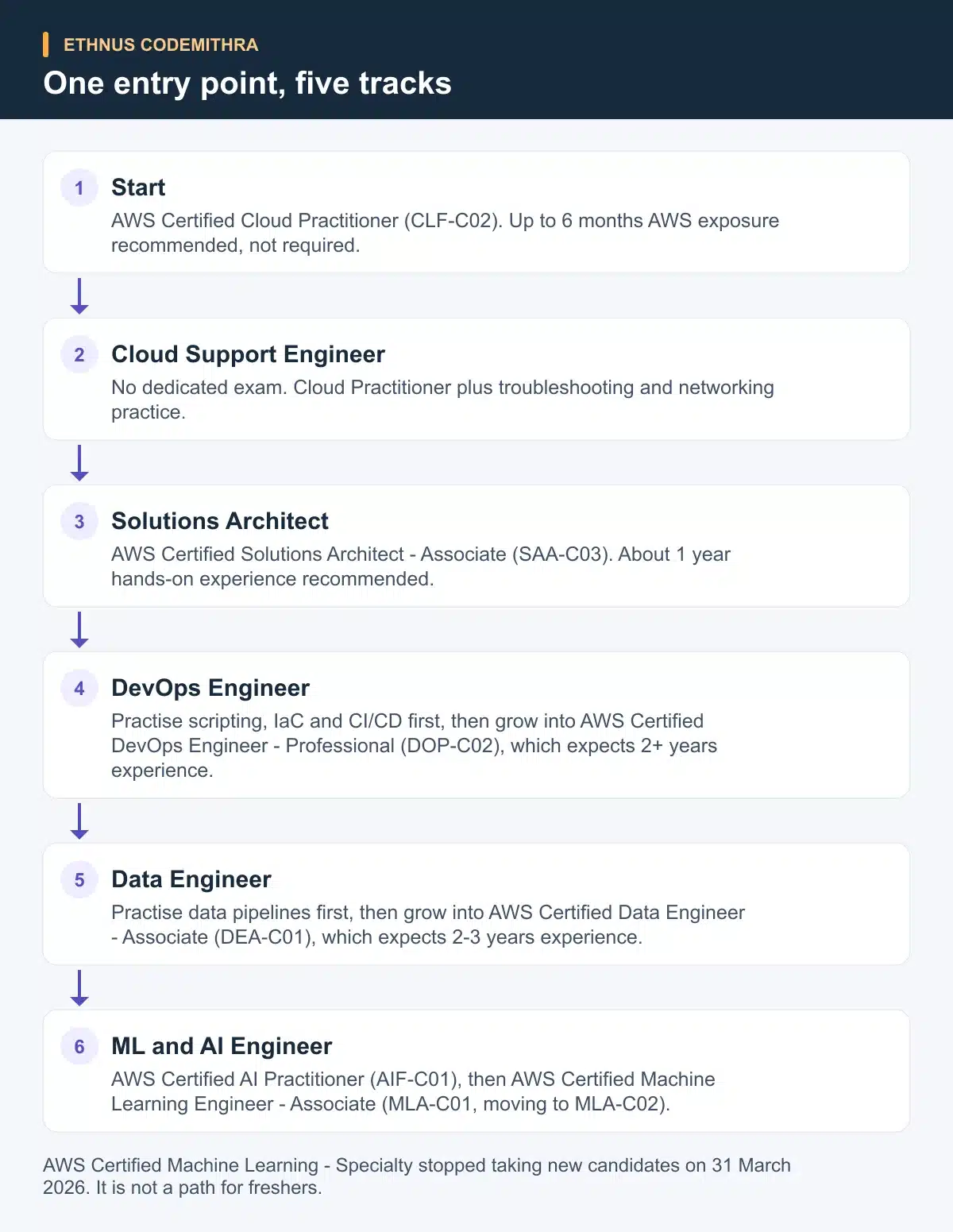
Five fresher-relevant AWS career tracks
Cloud support engineer
A cloud support engineer troubleshoots customer issues with AWS services, works through networking and system administration problems, and communicates fixes back to the customer. The role is customer-facing, so clear written and verbal explanation matters as much as the technical fix.
AWS does not publish a dedicated certification for this job title. Cloud Practitioner is the relevant foundation, paired with practical troubleshooting and basic Linux and networking skills built through hands-on practice.
Solutions architect
A solutions architect designs AWS infrastructure for a specific workload. That means choosing compute, storage, and networking services, keeping the design resilient and secure, and controlling its running cost. The output is a design that a build team then implements.
AWS Certified Solutions Architect - Associate (SAA-C03) is the certification for this track. AWS recommends about one year of hands-on experience designing AWS solutions, again as a recommendation rather than a strict prerequisite. The exam has 65 questions, runs 130 minutes, costs 150 USD, and stays valid for three years.
DevOps engineer
A DevOps engineer automates how software gets built, tested, and deployed on AWS. Scripting and infrastructure-as-code let environments get recreated reliably instead of configured by hand each time. The role sits between a development team and an operations team.
AWS Certified DevOps Engineer - Professional (DOP-C02) is the certification tied to this track. AWS recommends two or more years of experience provisioning, operating, and managing AWS environments, plus a background in software development lifecycle practices and scripting. That makes it a destination for a fresher, not a first exam. Start by practising scripting, infrastructure-as-code tools, and continuous integration pipelines while working toward it, alongside Cloud Practitioner.
Data engineer
A data engineer builds and maintains the pipelines that move data into and through AWS. The work uses services for storage, extract-transform-load tasks, and data warehousing, so other teams can query reliable data. Attention to data quality and governance is part of the job, not an add-on.
AWS Certified Data Engineer - Associate (DEA-C01) is the recommended certification. AWS recommends two to three years of data engineering or architecture experience, including one to two years hands-on with AWS. This is another experience-gated destination, not a day-one exam. The exam has 65 questions, runs 130 minutes, and costs 150 USD. This certification launched in 2024, after the previous version of this article was written. It did not exist as an option for freshers back then.
Machine learning and AI engineer
A machine learning engineer builds, trains, and deploys ML models on AWS, commonly using a managed service such as SageMaker. The work turns data into a working model that another application can call. This track has changed the most since 2023.
AWS Certified AI Practitioner (AIF-C01) did not exist when the original version of this article was written. It validates foundational AI, ML, and generative AI concepts rather than the ability to build a solution. AWS suggests it as a starting point for someone new to AWS or IT. The exam has 65 questions, runs 90 minutes, and costs 100 USD.
The next step is AWS Certified Machine Learning Engineer - Associate. As of September 2026, the current version is MLA-C01, and its last day in English is 28 September 2026. An updated MLA-C02 opened for beta registration on 1 September 2026, with delivery starting 29 September 2026. The standard version becomes available in all languages in early 2027. MLA-C02 adds generative AI, agentic AI, foundation models, and expanded Amazon Bedrock content, per AWS's own update announcement. A reader starting now should expect to sit whichever version is current by the time they are ready.
One certification to avoid planning around: AWS Certified Machine Learning - Specialty stopped accepting new exam sittings on 31 March 2026. AWS now directs candidates to Machine Learning Engineer - Associate instead. Existing holders keep their credential active for three years from the date they earned it. A fresher should not target this exam.
Comparing the five tracks
The table below replaces salary figures with the detail a fresher actually needs to plan around. It shows what the role does, which services it touches, and whether the certification is open on day one or built toward over time.
| Role | Core responsibility | Key AWS services | Recommended certification | Experience note |
|---|---|---|---|---|
| Cloud support engineer | Troubleshoot customer issues, resolve networking and system problems | EC2, IAM, CloudWatch | Cloud Practitioner (CLF-C02) | No dedicated exam for this title, foundation only |
| Solutions architect | Design resilient, secure, cost-optimised infrastructure | EC2, S3, VPC, RDS | Solutions Architect - Associate (SAA-C03) | About 1 year recommended, not required |
| DevOps engineer | Automate build, test and deployment pipelines | CodePipeline, CloudFormation, ECS | DevOps Engineer - Professional (DOP-C02) | 2+ years recommended by AWS |
| Data engineer | Build and maintain data pipelines and warehousing | Glue, Redshift, S3 | Data Engineer - Associate (DEA-C01) | 2 to 3 years recommended by AWS |
| ML and AI engineer | Build, train and deploy ML models | SageMaker, Bedrock | AI Practitioner (AIF-C01), then ML Engineer - Associate | AI Practitioner has no required prerequisite |
An exercise to try today
Pick the one track above that matches the work described, not the certification name. Then check the exam guide for its certification on the AWS certification page linked in that section. List three exam objectives you could already explain in one sentence each. Where you cannot, that gap is your starting study list, not a reason to pick a different track.
How to get started with Ethnus
Ethnus Codemithra's AWS Cloud Practitioner Essentials course runs 50 or more hours across 11 modules. Modules run from an introduction to AWS through to Cloud Practitioner exam basics, with sandbox lab access and career counselling. This is the foundation course that matches the shared starting point described above.
For the solutions architect track specifically, the AWS Solutions Architect Associate course runs 150 or more hours within a 320-hour curriculum. Its modules cover designing resilient, high-performing, secure, and cost-optimised architectures. It includes sandbox labs with unlimited attempts and live doubt-clearing sessions. Placement support covers a resume workshop and practice interviews, and the course prepares students for the SAA-C03 exam named above. A reader who wants a shorter first look can try the AWS Cloud Masterclass instead. This webinar runs about three hours and includes a hands-on facial recognition build. It ends with a joint Ethnus and NASSCOM FutureSkills certificate for scoring 60% or higher.
None of these courses award an AWS certification directly. AWS issues the certification after the candidate passes AWS's own exam.
Conclusion
Match your track to the work you want to do, not the certification that sounds most senior. Cloud Practitioner is the realistic first exam for all five tracks. Solutions Architect Associate and AI Practitioner are open to a fresher without required prior experience. DevOps Engineer Professional and Data Engineer Associate are certifications to grow into instead. Start with Ethnus Codemithra's AWS Solutions Architect Associate course if design work interests you, or the Cloud Practitioner Essentials course if you are still deciding.
Frequently asked questions
What AWS job roles can a fresher realistically target?
Cloud support engineer, solutions architect, DevOps engineer, data engineer, and machine learning or AI engineer. All five build on AWS Certified Cloud Practitioner as a shared foundation.
Which certification should I pursue for each role?
Use Cloud Practitioner (CLF-C02) for support roles and Solutions Architect - Associate (SAA-C03) for architecture. Use AI Practitioner (AIF-C01) then Machine Learning Engineer - Associate for ML and AI. DevOps Engineer - Professional (DOP-C02) and Data Engineer - Associate (DEA-C01) are the destination certifications for those two tracks.
Is prior experience required for these certifications?
For Cloud Practitioner, Solutions Architect - Associate, and AI Practitioner, AWS recommends experience but does not require it. DevOps Engineer - Professional and Data Engineer - Associate genuinely expect two or more years of relevant experience.
Is AWS Certified Machine Learning - Specialty still worth pursuing?
No. AWS stopped accepting new sittings for this exam on 31 March 2026 and now directs candidates to Machine Learning Engineer - Associate instead.
Does finishing an Ethnus course give me an AWS certification?
No. Ethnus courses prepare a student for the relevant AWS exam. AWS itself awards the certification once the student passes that exam.